Rebar locating before concrete repair is a small investigation step that can prevent expensive field mistakes. Before crews drill anchors, cut a slab, remove unsound concrete, extract cores, or install post-installed dowels, the repair team needs to know where reinforcing steel, prestressing, embedded plates, conduits, and congested lap zones may be present. Good drawings help, but existing structures often include undocumented changes, repair patches, abandoned sleeves, or reinforcement placed differently from the record set.
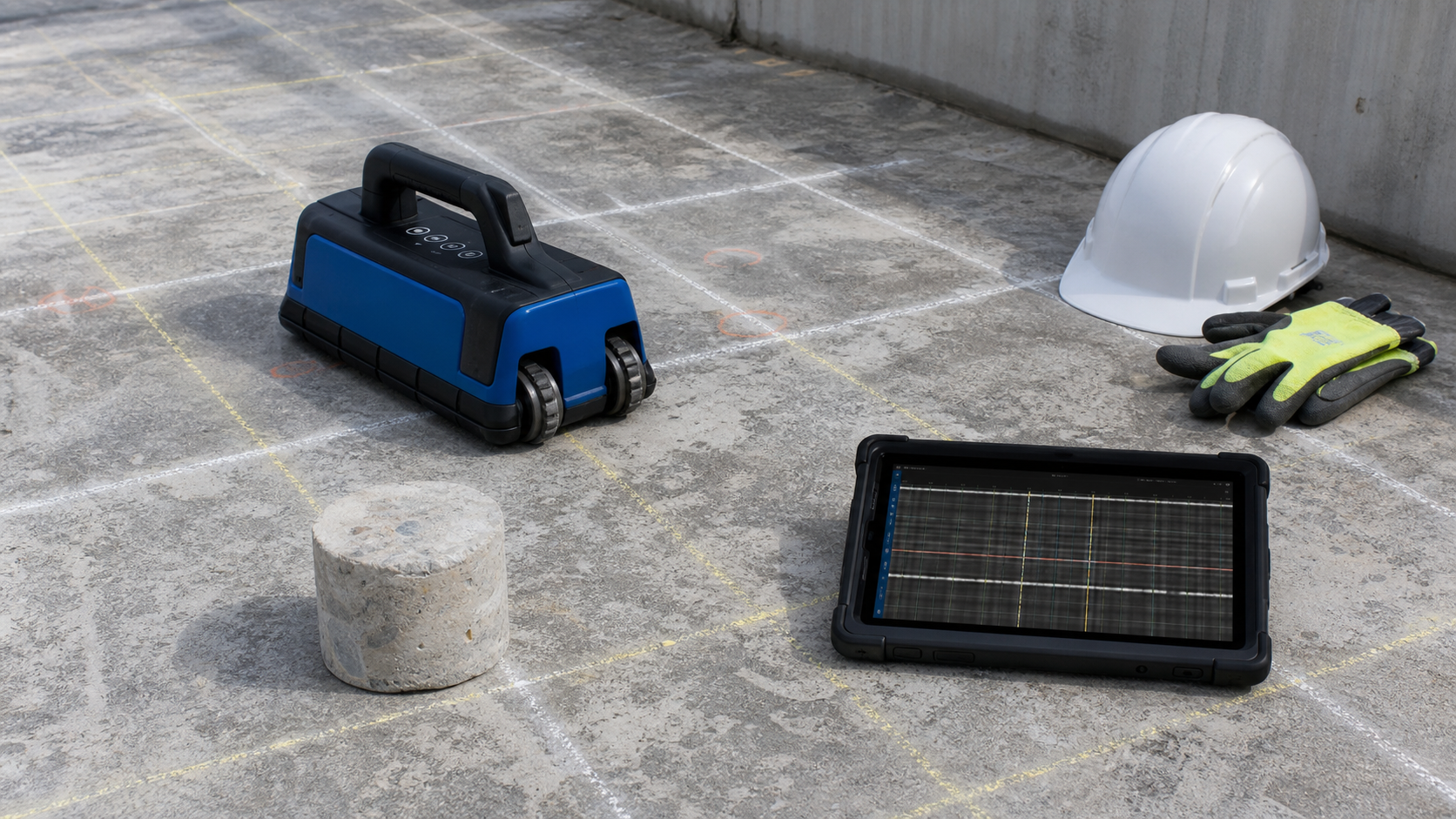
The goal is not to make the concrete transparent. The goal is to reduce uncertainty enough that the engineer can set repair limits, protect the load path, and write practical hold points. Cover meters, ground penetrating radar, selective verification openings, and careful documentation each have a place. Used together, they convert a risky demolition or drilling operation into a controlled repair activity with defined no-cut zones and escalation triggers.
Why reinforcement locating belongs in the repair plan
Concrete repair work often starts with removal. That is where the risk begins. Saw cuts can sever top mat bars near spalls, drilling can hit stirrups or tendons, and overbreak can expose more steel than expected. If a contractor discovers reinforcement only after equipment is already on the element, the project can lose time while the engineer reassesses capacity, lap length, corrosion treatment, or anchor layout.
ACI repair resources emphasize that assessment, design, durability, construction, and quality assurance are linked throughout concrete repair. A reinforcement map supports that chain. It helps the licensed design professional decide whether the repair is nonstructural patching, structural section restoration, strengthening, corrosion mitigation, or a combination of actions.
For owners, this is also a budget-control issue. A measured layout can reduce contingency, but it can also reveal hidden constraints early. The right question is not whether every bar can be located perfectly. The better question is whether the repair documents define enough verified information to let work proceed without guessing at critical locations.
Cover meter, GPR, and selective exposure are not interchangeable
Cover meters
A cover meter is commonly used to locate ferromagnetic reinforcement and estimate cover depth. It is useful for finding near-surface reinforcing steel, checking spacing, comparing cover variation, and selecting safer locations for cores or anchors. The Concrete Society notes that cover readings depend on knowing or confirming bar size, and that close spacing or lapped bars can make interpretation more difficult. That limitation matters in beams, columns, wall boundaries, slab bands, and repair areas where reinforcement congestion is expected.
Ground penetrating radar
GPR uses reflected electromagnetic waves to detect contrasts within concrete. FHWA’s Long-Term Bridge Performance protocol lists GPR uses that include characterizing reinforcement presence, pattern, depth, and density, estimating deck thickness, and identifying anomalies such as post-tensioning conduits. FHWA guidance also explains an important limitation: electromagnetic waves do not penetrate metals, and moisture or high chloride content can attenuate the signal. That means GPR is powerful, but still needs interpretation and validation.
ASTM D6087 addresses GPR procedures for evaluating bridge decks with asphalt, portland cement concrete overlays, or no overlay. Its scope is bridge deck condition assessment rather than a universal building-repair scan, but it is still useful because it shows where GPR fits in systematic rehabilitation investigations and why results should not be stretched beyond the method’s purpose.
Selective exposure and ground truth
When the repair decision depends on exact bar size, lap condition, corrosion state, tendon position, or remaining section, non-destructive methods may need selective verification. That can mean a small chipping window, a pilot hole in a low-risk location, or an exposed edge that lets the team calibrate cover readings. FHWA’s bridge deck GPR protocol specifically calls for validation by comparison with other NDE methods and ground truth data. The same principle applies to building repair work.
Where to require rebar locating before repair work
Rebar locating is most valuable where the proposed work could damage reinforcement or where reinforcement position controls repair design. Common cases include core drilling, anchor drilling, dowel installation, slab openings, expansion joint replacement, overhead delamination repair, beam soffit repair, column jacketing preparation, and deck removal around embedded items.
It also belongs before post-installed rebar dowel work. Dowels need embedment, spacing, edge distance, hole cleaning, adhesive cure, and inspection, but they also need a drilling path that does not damage existing bars. Locating reinforcement helps the engineer adjust layout before field drilling forces a rushed decision.
For repairs involving loss of cover, rebar maps should be reviewed alongside concrete cover restoration requirements. If shallow cover caused corrosion, simply patching back to the same geometry may recreate the original durability problem. Locating the steel helps define whether the repair needs cover build-up, coating, galvanic anodes, cathodic protection, or a surface protection system after the repair is accepted.
A practical workflow for owners and engineers
1. Define the decision before scanning
Start with the field question. Are you trying to avoid bars during coring, confirm cover depth for durability, locate tendons before cutting, map reinforcement for structural analysis, or find safe anchor locations? A broad scan with no decision attached can produce a colorful report that does not change the repair plan. A decision-based scope keeps the survey efficient.
2. Review drawings and visible clues
Record drawings, shop drawings, previous repair details, construction joints, cracks, rust staining, exposed bars, and slab thickness changes all inform the scan plan. Drawings should be treated as evidence, not proof. If the structure has been modified, the locating plan should include extra checks at transitions and critical load path areas.
3. Choose the right method combination
Use cover meter work for near-surface bar location and cover checks where reinforcement is not too congested. Use GPR where deeper mapping, second mats, deck thickness, anomalies, or broader survey production are important. Add selective exposure when bar size, condition, or exact geometry must be confirmed. If the repair also depends on delamination, bond, or substrate condition, coordinate the scan with pull-off adhesion testing, sounding, or other NDE rather than treating rebar locating as the whole assessment.
4. Mark, document, and protect the results
Field marks should be durable enough for the next trade and clear enough to distinguish top bars, bottom bars, suspected conduits, verified openings, no-drill zones, and uncertainty areas. The report should include equipment type, date, access limits, calibration assumptions, scan grid, marked photos, confidence level, and locations where verification is required before cutting or drilling.
5. Convert the survey into repair controls
The survey is only useful if it changes the construction documents or field controls. Typical outputs include revised anchor layouts, prohibited saw-cut depths, maximum chipping depth before engineer review, hold points before bar cutting, permitted core zones, and requirements for additional scanning when work extends beyond mapped limits.
Quality gates that should be in the specification
A repair specification should identify who performs the locating, what area is scanned, how results are marked, what accuracy is required for the decision, and what happens when the scan conflicts with drawings. It should also state that reinforcement, prestressing steel, embedded conduits, or structural inserts may not be cut unless the licensed design professional explicitly approves the change.
Surface preparation matters too. Rough, wet, contaminated, coated, or heavily scaled concrete can affect scanning and marking. The scan plan should be coordinated with concrete surface profile requirements so that investigation, demolition, and bonding preparation do not fight each other. If repair materials will be placed immediately after removal, selection should also align with concrete repair material selection and curing constraints.
For corrosion-driven repairs, locating data should be reviewed with chloride, carbonation, half-cell, resistivity, and delamination information. The repair team may need a protection strategy after patching, especially where exposure remains aggressive. That is where concrete surface protection after repair becomes part of the durability plan instead of an optional coating decision at the end.
Limitations to state plainly
Rebar locating does not certify structural capacity by itself. It does not prove corrosion activity, bond condition, residual bar area, concrete strength, or tendon condition unless combined with other evidence. Cover meter results can be distorted by nearby bars, lapped bars, mesh, embedded steel, and unknown bar diameters. GPR interpretation can be affected by moisture, chlorides, overlays, reinforcement congestion, metal reflectors, and access limits.
These limitations should not discourage testing. They should shape the scope. A good survey states where confidence is high, where uncertainty remains, and what field action is allowed before the engineer is called. That is the difference between using NDE as an engineering input and treating it as a magic scan.
FAQ
Is GPR always better than a cover meter?
No. A cover meter can be efficient for near-surface reinforcement and cover checks. GPR is better suited when broader mapping, deeper features, second mats, thickness, or anomalies are important. Many repair projects benefit from both.
Can rebar locating prevent every bar strike?
No method can guarantee that. It reduces risk when performed, interpreted, marked, and verified properly. Critical drilling and cutting should still use depth controls, hold points, and engineer review when unexpected steel is found.
When should selective exposure be required?
Require it when exact bar size, lap condition, corrosion state, tendon position, or remaining section controls the repair decision. It is also useful for calibrating scan results where drawings are missing or congested reinforcement makes interpretation uncertain.
Should the contractor or engineer perform the scan?
Either may perform it if qualified, but the repair documents should say who is responsible for interpretation, what must be submitted, and when the licensed design professional must approve changes to drilling, cutting, or removal limits.
Sources
- ACI 562 Repair Code portal
- ACI CODE-562-25 product details
- FHWA LTBP protocol: Ground Penetrating Radar Testing for Bridge Decks
- FHWA InfoTechnology: Ground Penetrating Radar
- ASTM D6087-22: GPR evaluation of concrete bridge decks
- The Concrete Society: Reinforcement depth and cover meters
Plan the scan before the repair starts
Structural Rehab helps owners and project teams turn uncertain concrete conditions into practical repair scopes, inspection hold points, and durability decisions. For early planning, book a consultation or download the free structural health guide so the next repair starts with better information instead of field guessing.
Need a professional structural assessment?
Book a consultation with Structural Rehab to evaluate repair priorities, corrosion risks, and rehabilitation options before damage escalates.
Book Consultation