Aging reinforced concrete columns often need two repairs at the same time: structural rehabilitation and corrosion control. Textile-reinforced mortar, often discussed with fabric-reinforced cementitious matrix systems, can help add confinement or local strengthening with a mineral matrix. Corrosion inhibitors can help slow electrochemical corrosion activity when they are selected and installed as part of a verified durability strategy.
The combination is attractive because the column repair is not only about wrapping a member. It is about diagnosing why the reinforcement is corroding, restoring or improving the load path, protecting the steel environment, and verifying that the new jacket bonds and performs as intended. This guide explains where TRM and corrosion inhibitors can fit, what must be checked before use, and when a different repair strategy may be safer.
What TRM Does in Column Repair
TRM systems use fiber textiles embedded in an inorganic mortar matrix. In repair practice, you may also see related terms such as FRCM, fabric-reinforced cementitious matrix, or mineral-matrix composite strengthening. The key idea is that the textile provides tensile reinforcement while the mortar matrix transfers stresses, protects the textile, and creates a compatible cementitious layer on the concrete surface.
For reinforced concrete columns, TRM may be considered for confinement, shear strengthening, local jacket repair, or seismic retrofit detailing. It is not a cosmetic coating. It must be designed as a structural system, with the number of layers, textile orientation, lap length, corner radius, anchorage, substrate preparation, and quality control defined before work starts.
What Corrosion Inhibitors Can and Cannot Do
Corrosion inhibitors are chemicals intended to reduce corrosion activity at the reinforcing steel. They may be admixed into repair materials, applied to exposed reinforcement, or used as surface-applied migrating inhibitors depending on product type and project conditions. Their usefulness depends on chloride concentration, carbonation depth, moisture, concrete permeability, cracking, inhibitor dosage, application method, and whether the inhibitor can reach the steel in effective concentration.
Inhibitors should not be treated as a substitute for removing unsound concrete, cleaning heavily corroded reinforcement, replacing steel with critical section loss, correcting leakage, or protecting the repaired member from future exposure. They are best considered one part of a corrosion-control package, alongside drainage, cover restoration, low-permeability repair mortar, coatings, waterproofing, monitoring, or cathodic protection where justified.
Why the Combination Can Make Sense
TRM and corrosion inhibitors address different failure drivers. TRM can improve confinement or strengthening demand, while inhibitors target corrosion activity. For an aging RC column, the combined strategy may be useful when:
- The column has corrosion-related cover distress but remains a repair candidate after engineering assessment.
- The repair objective includes confinement, ductility improvement, or local strengthening, not just patching.
- The structure needs a mineral-matrix system because vapor permeability, temperature exposure, moisture tolerance, or fire behavior makes resin-bonded FRP less attractive.
- Corrosion risk extends beyond the visible spall, but full replacement or cathodic protection is not proportionate to the project objective.
- The owner can support periodic inspection and maintenance after repair.
The important point is sequencing. Diagnose corrosion first, repair the steel and concrete substrate, then install the TRM system over a surface that can actually transfer load.
Assessment Before Specifying TRM or Inhibitors
Before selecting the repair system, map the column condition and exposure. ACI CODE-562-25 provides a code framework for assessment, repair, and rehabilitation of existing concrete structures, including durability, corrosion, interface bond, strengthening, temporary works, and quality assurance considerations. For a column, the assessment should normally address:
- Crack pattern, spalls, delamination, rust staining, leakage paths, and previous patch repairs.
- Cover depth, reinforcement layout, bar section loss, tie condition, lap splice condition, and confinement detailing.
- Chloride profile, carbonation depth, half-cell potential, concrete resistivity, and moisture exposure where these results will change decisions.
- Axial load, moment demand, shear demand, seismic detailing gaps, and construction-stage stability.
- Substrate strength and surface soundness for bonded repair or jacket work.
Related diagnostic guides on this site include chloride testing before concrete repair, half-cell potential testing, and concrete resistivity testing before repair.
Practical Repair Sequence
1. Stabilize and expose the repair zone
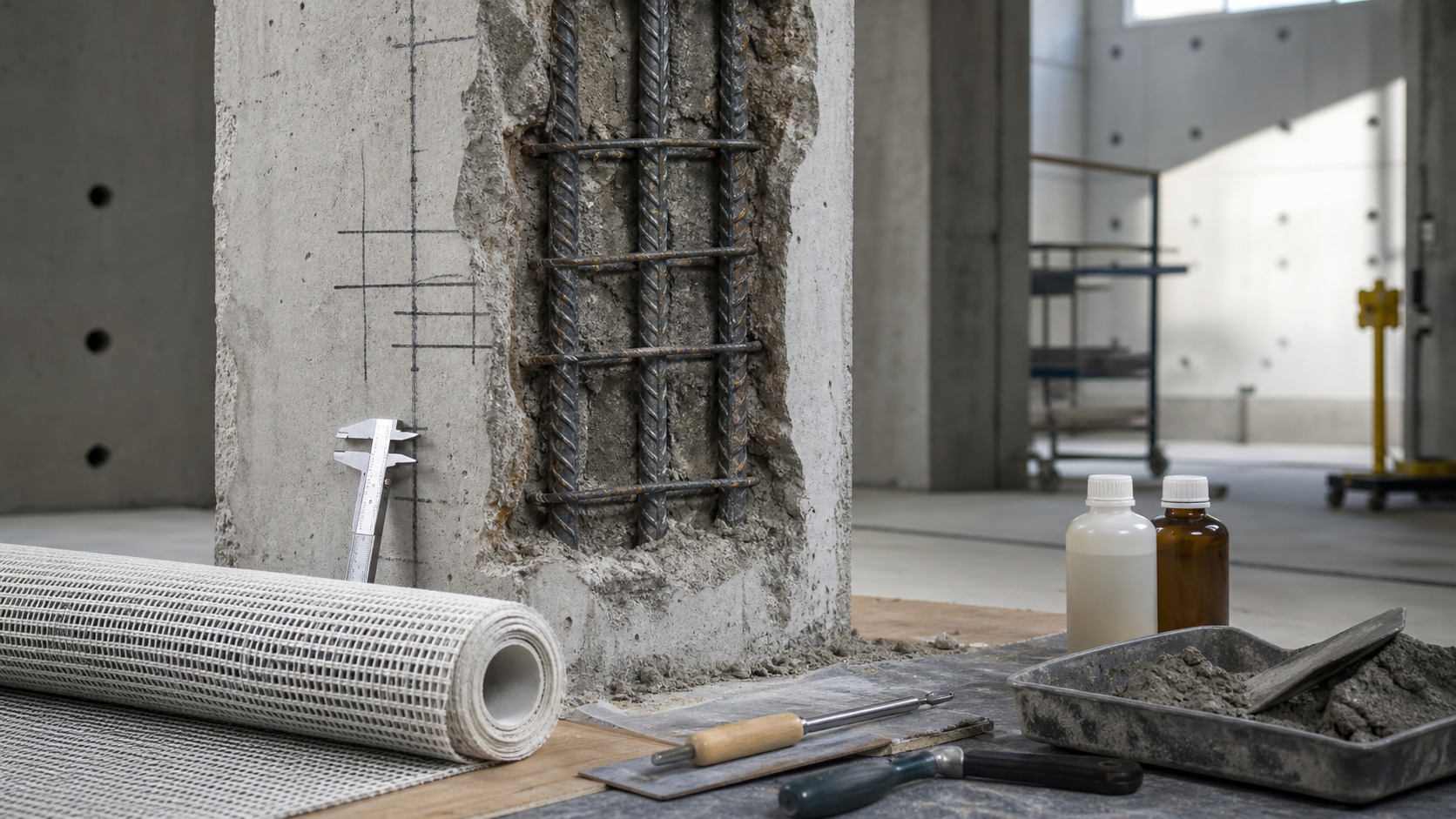
If the column has severe section loss, crushing, major cracking, or active load-path concerns, temporary shoring should be designed before removal begins. Remove unsound concrete to sound substrate, avoid feather edges, and expose corroded reinforcement enough to clean it properly.
2. Treat reinforcement and section loss
Clean reinforcement according to the specification, measure remaining bar diameter where corrosion is significant, and replace or supplement steel where section loss affects capacity. A corrosion inhibitor may be applied or incorporated only as specified by the engineer and product data, not as an informal site add-on.
3. Restore geometry with compatible repair mortar
Use a repair material compatible with the existing concrete, exposure, cover requirements, and TRM matrix. The repair layer must be properly compacted and cured. Poor curing, shrinkage cracking, or weak patch edges can undermine both corrosion protection and TRM bond.
4. Prepare the surface for TRM
TRM depends on a sound, clean, profiled surface. Remove laitance, dust, oil, curing compounds, weak patches, and loose material. Rounded corners are often needed on columns to avoid stress concentration and textile damage. See the related guide to concrete surface profile before repair.
5. Install textile and mortar layers
Install the matrix and textile in the specified sequence, keeping textile alignment, lap lengths, corner detailing, layer count, thickness, and curing under control. Do not substitute a different mesh, mortar, or inhibitor without engineering review because the tested system behavior may change.
6. Verify bond, coverage, and records
Quality control should include substrate approval, material batch records, installed layer checks, curing records, photos, and acceptance testing where specified. ASTM C1583/C1583M is commonly referenced for direct-tension pull-off testing of concrete surfaces and repair or overlay bond. For more context, see pull-off adhesion testing before concrete repair.
Design Checks That Matter
A TRM jacket for an RC column should be checked against the actual deficiency. For confinement, the engineer should consider concrete strength, column geometry, corner radius, jacket continuity, textile rupture strain, matrix cracking, lap location, and interaction with existing ties. For seismic retrofit, deformation capacity and detailing may matter more than peak strength. For durability, the repair should limit future moisture, chloride, carbonation, and crack exposure.
ICC-ES AC434 is one acceptance-criteria reference used for FRCM systems, and project specifications may require evaluated systems, manufacturer data, engineering calculations, mockups, or product-specific installation controls. The designer should also check whether local building rules, fire requirements, and existing-building provisions apply.
Limitations and Failure Modes
TRM plus corrosion inhibitors is not appropriate for every aging column. Be cautious when the column has major hidden section loss, inadequate foundations, poor concrete strength, active settlement, shear-critical damage, severe chloride contamination, ongoing water leakage, or unsafe temporary load conditions. Common failure modes and mistakes include:
- Strengthening over contaminated or weak concrete without correcting the corrosion environment.
- Using inhibitor claims without verifying dosage, penetration, substrate moisture, or chloride conditions.
- Ignoring bar section loss, tie corrosion, lap splice deficiencies, or inadequate confinement.
- Installing TRM around sharp column corners that damage textile fibers.
- Skipping curing and pull-off verification because the surface looks finished.
- Assuming a small laboratory result transfers directly to a different site exposure and geometry.
Specification Checklist
A project specification should define the repair goal before naming products. Include:
- Assessment findings, repair boundaries, and required temporary works.
- Concrete removal limits, reinforcement cleaning, and steel replacement rules.
- Approved corrosion inhibitor type, dosage, application method, and compatibility checks.
- Repair mortar properties, substrate moisture condition, surface profile, and curing requirements.
- TRM textile type, matrix, layer count, orientation, overlaps, corner radius, anchors, and terminations.
- Mockup requirements, hold points, pull-off testing, inspection records, and maintenance schedule.
FAQ
Is TRM the same as FRP?
No. FRP strengthening usually uses fibers with an organic resin matrix. TRM or FRCM systems use fibers in an inorganic mortar matrix. TRM may be preferred where a mineral matrix, vapor permeability, moisture tolerance, or fire behavior is important, but it still requires engineered design and tested system data.
Can corrosion inhibitors stop all reinforcement corrosion?
No. They may reduce corrosion activity when selected and applied correctly, but they cannot replace removal of unsound concrete, reinforcement repair, leakage correction, compatible repair mortar, and future protection. Their performance depends strongly on the existing concrete and exposure conditions.
Should every corroded column receive a TRM jacket?
No. Some columns need patch repair and protection only. Others need FRP, steel jacketing, section enlargement, cathodic protection, load reduction, or replacement. The right repair depends on capacity, corrosion risk, exposure, access, fire requirements, and service-life objectives.
How do you verify that the TRM repair is bonded well?
Verification starts before installation with substrate preparation and mockups. During and after installation, inspection records, curing checks, sounding, and specified pull-off testing can help confirm whether the repair layer and surface preparation are adequate.
Source Links
- ACI CODE-562-25: Assessment, Repair, and Rehabilitation of Existing Concrete Structures
- ICC-ES AC434 acceptance criteria for FRCM systems
- ASTM C1583/C1583M pull-off tensile and bond strength test method
- American Concrete Institute concrete repair topic page
Need a Column Repair Strategy?
Structural Rehab can help review corrosion distress, define a practical testing program, compare TRM, FRP, steel jacketing, patch repair, and corrosion-control options, and prepare a service-life plan. Review our structural rehabilitation services or book a consultation to discuss your structure.
Need a professional structural assessment?
Book a consultation with Structural Rehab to evaluate repair priorities, corrosion risks, and rehabilitation options before damage escalates.
Book Consultation