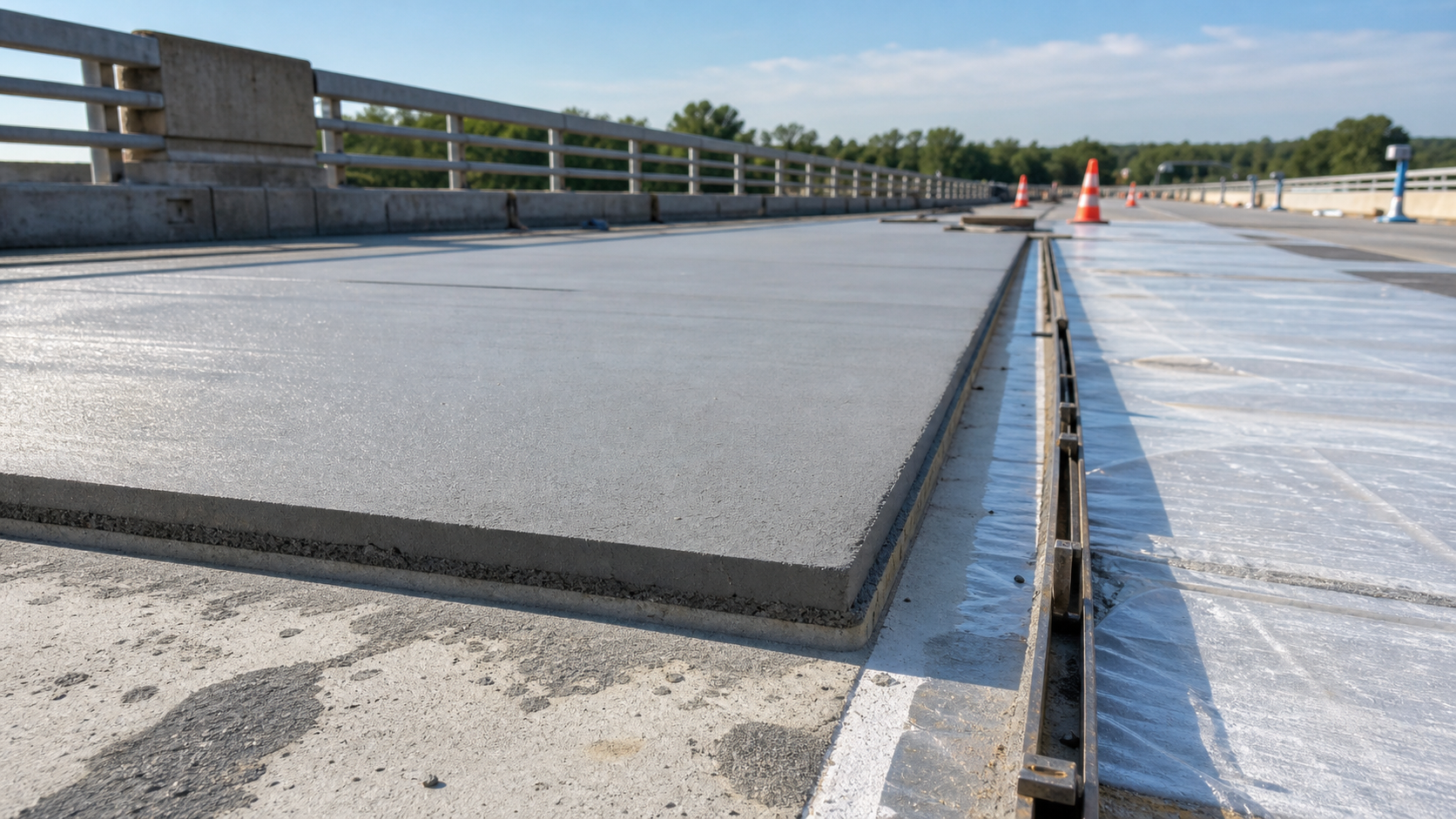
A UHPC bridge deck overlay can be a powerful rehabilitation option when an existing concrete deck needs durable protection, improved load distribution, and a thin bonded wearing or protection layer. FHWA describes ultra-high performance concrete as a bridge technology used for new construction and preservation, including deck overlays, girder end repairs, link slabs, and field-cast connections. For existing decks, the appeal is clear: a relatively thin layer can provide low permeability, durability, and composite action when the bond is properly developed.
A UHPC overlay should be selected because the deck needs bonded structural protection, not because the material name sounds advanced. It is not a universal resurfacing product. The deck still needs assessment, deteriorated concrete removal, surface preparation, joint and drainage review, material qualification, curing controls, and bond verification. Without those fundamentals, an expensive overlay can fail for ordinary reasons.
What Makes UHPC Different From Conventional Overlays
FHWA’s UHPC bridge deck overlay TechNote explains that thin bonded UHPC overlays have been studied as a way to protect the underlying deck and reinforcement from contaminant ingress while adding strength and stiffness. FHWA describes overlay thicknesses in the range of about 1 to 2 inches for the concept it studied, which limits added dead load compared with thicker conventional concrete overlays. UHPC’s dense matrix and fiber reinforcement can provide very low permeability and strong durability potential.
Those advantages come with stricter requirements. UHPC mix behavior, batching, placement time, substrate condition, curing, and profile control are not the same as ordinary concrete. The overlay must be compatible with bridge grade, cross slope, drainage details, expansion joints, approach transitions, and construction staging. Contractors and inspectors need a project-specific plan rather than a generic concrete overlay specification.
The owner should also decide how the overlay will be maintained. Even a very dense overlay can be damaged by leaking joints, snowplow impact, poor drainage, or unsealed construction defects. The preservation plan should define inspection intervals, joint maintenance, crack review, and documentation responsibilities after traffic returns.
When a UHPC Overlay Is a Good Candidate
A UHPC overlay is most credible when the existing deck has enough remaining structural value to preserve, but needs durable protection and improved serviceability. Candidate decks may have shallow deterioration, chloride exposure, cracking, permeability concerns, or a need for a thin overlay with limited added dead load. A good candidate also allows the surface to be prepared to a profile that supports bond without exposing too much reinforcement or creating widespread unsound concrete.
The decision should be compared against conventional concrete overlays, latex-modified concrete, polymer overlays, membranes with asphalt, deck replacement, and staged partial-depth repair. Structural Rehab’s repair versus replace guide is useful because overlay selection is ultimately a life-cycle decision, not only a bid-line choice.
Deck Assessment Before Selection
Before specifying UHPC, evaluate the deck. Map cracks, delamination, patches, scaling, leakage, rutting, drainage problems, joint leakage, exposed reinforcement, and previous overlay performance. Use sounding, chain drag, GPR, cores, chloride testing, cover measurements, and selective openings as appropriate. A concrete delamination survey should define removal limits so the overlay is not bonded to separated cover concrete.
Check structural demand as well. If the deck has section loss, reinforcement corrosion, punching shear concerns, fatigue-critical details, or inadequate capacity, the overlay may need to be part of a strengthening design. Do not assume the material solves load rating issues automatically. Composite action depends on bond and detailing, and the engineer must account for existing deck condition.
Surface Preparation and Bond
FHWA’s field-testing report notes that the deck surface should be roughened to facilitate bond and that good bond is required to develop composite action between UHPC and existing concrete. This is where many overlay projects succeed or fail. Remove unsound concrete, contaminants, laitance, membranes, weak paste, and poorly bonded previous patches. Establish a specified surface profile and verify it in the field.
Structural Rehab has detailed guides on concrete surface profile before repair and pull-off adhesion testing. For UHPC overlays, the specification should define the required profile, cleaning method, moisture condition, pre-placement acceptance, trial placement, and bond testing or mockup requirements.
Details That Can Defeat a Good Overlay
Joints and Drainage
Water paths at expansion joints, scuppers, curbs, deck edges, and parapet lines can continue to damage the deck if not corrected. If the bridge has active expansion joint leakage, fix the drainage path and joint detailing before expecting the overlay to protect the structure.
Transitions and Ride Quality
A thin overlay still changes grades at approaches, joints, drains, and lane interfaces. The design should coordinate milling depth, overlay thickness, screed control, drainage slope, and tie-ins so the final riding surface performs as intended.
Curing and Early-Age Protection
UHPC materials can be sensitive to temperature, mixing energy, placement timing, and curing procedures. The contractor should submit a thermal and curing plan, contingency measures for weather, and acceptance criteria for opening to traffic. Early drying, poor finishing, or uncontrolled cold joints can undermine the overlay’s intended durability.
Inspection Access
Overlays can hide the original deck surface. That makes baseline documentation important. Keep pre-repair photos, delamination maps, removal records, substrate acceptance records, batch logs, and post-placement test results in the bridge file so future inspectors understand what was covered and why.
QA/QC Checklist for Owners
- Require a deck condition report before final overlay selection.
- Define removal limits and acceptance of exposed substrate before placement.
- Use trial panels or mockups when the project team lacks local UHPC overlay experience.
- Verify surface profile, cleanliness, moisture condition, and temperature before placement.
- Track batching, mixing time, flow or workability, fiber distribution, placement time, finishing, and curing.
- Document bond checks, compressive strength or project-specific material acceptance tests, and opening-to-traffic criteria.
When UHPC May Not Be the Right Answer
UHPC may be a poor fit when the deck is too deteriorated to preserve, when widespread full-depth removal is expected, when the contractor cannot control surface preparation and curing, when joint leakage will continue, or when traffic staging leaves no practical placement window. It can also be hard to justify when a lower-cost overlay meets the service-life requirement with less construction risk.
The owner should ask for an alternatives analysis. Compare expected service life, traffic impacts, dead load, repair extent, quality-control burden, future inspection access, and total cost. The best solution may be UHPC, conventional overlay, localized patching plus waterproofing, or deck replacement depending on the structure.
FAQ
Is a UHPC overlay structural?
It can contribute structurally when designed for composite action and properly bonded, but the engineer must verify the existing deck, bond assumptions, and load path.
How thick is a UHPC bridge deck overlay?
FHWA’s overlay TechNote discusses thin bonded UHPC overlays around 1 to 2 inches for the studied concept. Project thickness should be engineered for the bridge, profile, and service objective.
Can UHPC be placed over delaminated concrete?
No. Unsound or delaminated concrete must be identified and removed. A strong overlay cannot compensate for a weak or separated substrate.
What is the biggest construction risk?
Bond-related execution risk is high: removal limits, surface profile, cleanliness, moisture condition, placement timing, and curing all matter.
Sources
- FHWA: Ultra-High Performance Concrete for Bridges
- FHWA-HRT-17-097: Ultra-High Performance Concrete for Bridge Deck Overlays
- FHWA-HRT-17-096: Field Testing of a UHPC Overlay
- FHWA Bridge Preservation resources
Planning a bridge deck rehabilitation? Structural Rehab can review deck assessment data, overlay alternatives, and QA/QC requirements before procurement. Book a consultation or explore our structural rehabilitation services.
Need a professional structural assessment?
Book a consultation with Structural Rehab to evaluate repair priorities, corrosion risks, and rehabilitation options before damage escalates.
Book Consultation