Why load testing belongs in some repair decisions
Load testing existing concrete structures is not a routine checkbox. It is a controlled engineering investigation used when drawings, material tests, inspection records, and analysis still leave an important question unanswered. A parking deck may have undocumented reinforcement. A transfer slab may show deflection that does not agree with available calculations. A beam may have been altered by penetrations, fire, corrosion, or construction defects. In those cases, a carefully planned test can help show how the structure behaves under a known load before the owner commits to strengthening, replacement, or continued service.
A load test should answer one narrow engineering question, not become a substitute for diagnosis. The question may be whether a member can safely resist a specified service load, whether a repair has restored stiffness, or whether an analytical model is too conservative for the real boundary conditions. If the question is vague, the test will produce data without a decision. That is expensive and risky.
For Structural Rehab clients, the best use of load testing is usually after a structured condition assessment. Visual distress, delamination mapping, corrosion testing, concrete strength estimates, reinforcement locating, and calculations should come first. The test then targets the remaining uncertainty. This keeps the work defensible and avoids loading a structure that has not been screened for brittle failure modes.
When a load test may be justified
Consider load testing when the structure is important enough that conservative replacement is costly, but the available information is not strong enough to approve continued service by analysis alone. Common triggers include missing as-built drawings, suspected construction deviations, unusual cracking or deflection, change of use, increased storage loads, uncertain fire or impact damage, and disputes over whether a repair has restored performance.
It can also help when existing reinforcement is difficult to verify without destructive openings. Ground penetrating radar, cover meters, and selective chipping can reduce uncertainty, but they do not always define anchorage, continuity, bar grade, or hidden discontinuities. A measured response under controlled loading can support the engineering judgment, provided the test is designed around the governing limit state.
Load testing is less suitable when the likely failure mode is sudden, brittle, or poorly understood. Punching shear, anchorage failure, shear distress, severe corrosion section loss, active settlement, and unstable cracking require special caution. In many of those cases, shoring, repair, or replacement planning may be safer than applying a proof load.
What to verify before any load is applied
Confirm the structural question
The engineer should define the target member, the load effect being tested, the required acceptance criteria, and the decision that will follow. A good test plan states what will be accepted, what will trigger unloading, and what additional action is required if the response is borderline. Without that discipline, the owner may end up with graphs but no answer.
Complete the condition assessment first
Before testing, document cracking, spalling, delamination, reinforcement corrosion risk, prior repairs, moisture exposure, and support conditions. Our guide to concrete delamination surveys before repair explains why hidden separation can change repair limits and test safety. If the load test is meant to validate a bonded repair or overlay, the repair interface should also be checked with methods such as pull-off adhesion testing.
Model the test before mobilizing
A structural model is still needed. It predicts load distribution, deflection range, critical sections, expected recovery, and possible redistribution. The model also helps place instruments at locations where movement matters. If the model says the test load path is ambiguous, the plan should be revised before tanks, weights, or hydraulic jacks arrive on site.
Instrumentation that makes the test useful
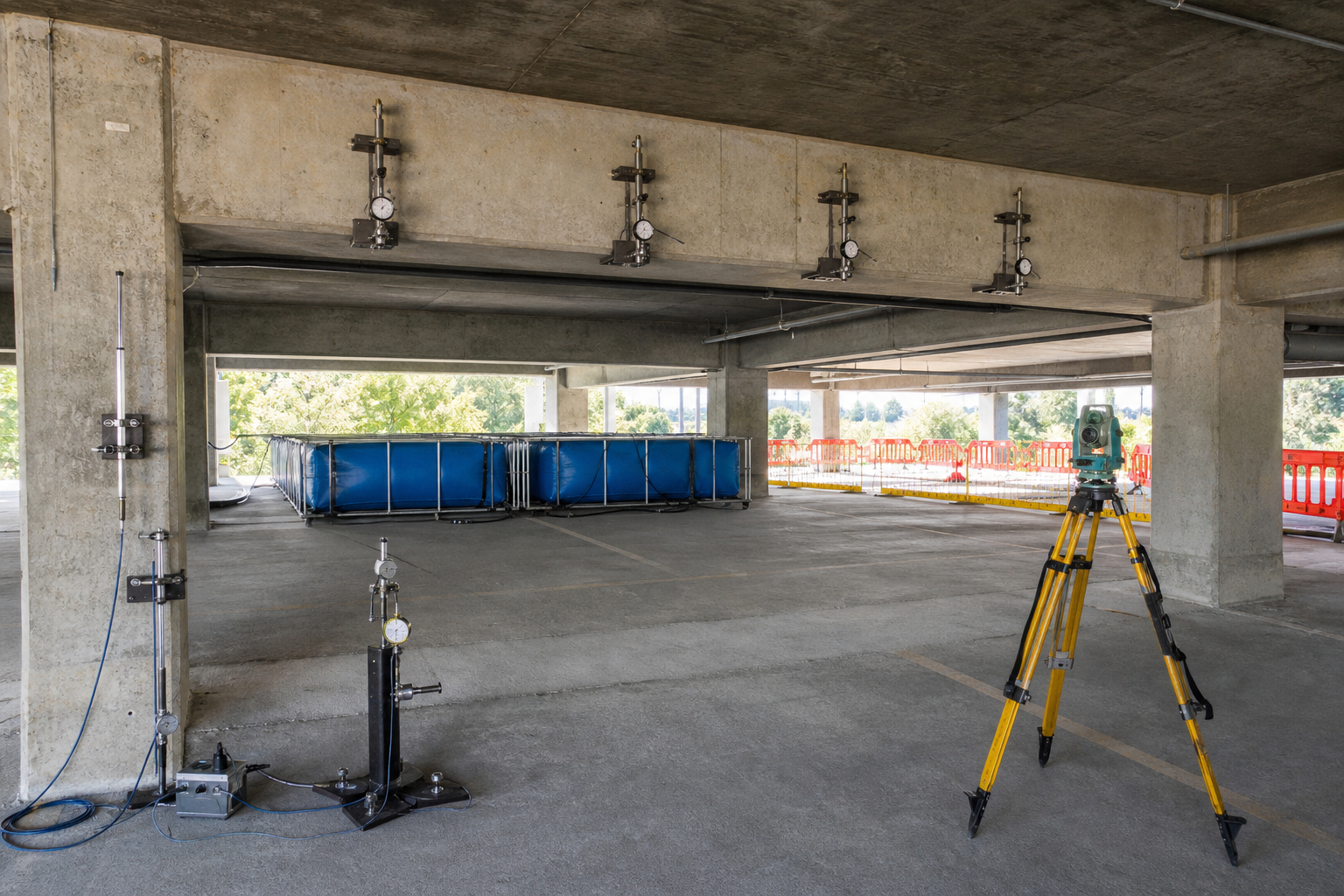
At minimum, a load test should measure applied load, deflection, crack behavior, and recovery after unloading. Depending on the structure, the plan may include dial gauges, linear variable differential transformers, survey levels, strain gauges, crack gauges, load cells, data loggers, temperature readings, and independent benchmarks. The instruments must be protected from vibration, accidental contact, and reference movement.
Good instrumentation is not about collecting the most channels. It is about measuring the response that proves or disproves the engineering assumption. For a slab, deflection profile and crack reopening may matter more than a single midspan reading. For a beam with suspected continuity, readings near supports can be as important as midspan. For a repaired member, movement across the repair boundary may reveal a weakness that total deflection hides.
Loading method and safety controls
Water tanks, calibrated blocks, hydraulic jacks, and staged vehicle loading can all be valid when engineered properly. The best method depends on access, load magnitude, distribution, sensitivity, and emergency unloading requirements. Water is useful because it can be added gradually and removed quickly, but tanks need containment, level monitoring, and floor protection. Solid weights are stable but harder to remove fast. Hydraulic systems need calibrated gauges and load paths that do not create unintended local crushing.
The plan should include exclusion zones, temporary shoring if required, communication procedures, stop criteria, weather limits for exterior work, and a responsible engineer with authority to halt the test. The owner should not allow field improvisation once loading has begun. If response exceeds predictions, if cracks propagate unexpectedly, or if instruments behave unreliably, the test should pause until the engineer decides whether it can continue.
How results should be interpreted
A successful load test is more than a member surviving a single load. The engineer should review deflection magnitude, linearity, residual deflection, crack response, signs of distress, and agreement with the predicted behavior. Recovery after unloading is often important because excessive residual movement can indicate damage or nonlinear behavior that is not acceptable for continued service.
Results should be tied to the intended use of the structure. Passing a test for a defined service condition does not automatically justify a different occupancy, heavier storage, new equipment, or future deterioration. It also does not erase corrosion risk, chloride contamination, poor drainage, or weak repair materials. Those durability issues still need a repair and maintenance plan.
Common mistakes
The first mistake is testing too early. If the team has not identified the likely defect, a load test can mask the real problem. The second is testing too much area with too little instrumentation. The third is choosing a load pattern that is convenient but does not represent the critical structural effect. The fourth is using load testing to avoid hard decisions about severe deterioration. A structure with active corrosion, falling concrete, or unstable supports needs risk reduction before proof loading.
Another mistake is treating the test result as a permanent certificate. Existing structures change. Water leaks, chloride ingress, fatigue, vibration, and thermal movement can continue after the test. The result belongs in a broader asset plan that includes monitoring, maintenance, and future inspections.
Owner decision checklist
- Has a licensed structural engineer defined the exact question the test must answer?
- Have drawings, inspections, material tests, and reinforcement surveys been reviewed first?
- Are the critical failure modes understood well enough to test safely?
- Does the loading method represent the real demand without creating artificial damage?
- Are stop criteria, emergency unloading, and exclusion zones written into the plan?
- Will the final report connect the measured response to a repair, strengthening, or service decision?
How this connects to repair planning
Load testing often sits between assessment and intervention. If the test confirms adequate behavior, the owner may still need durability repairs, waterproofing, monitoring, or localized strengthening. If it fails, the data helps size a repair more intelligently. Our ACI 562 repair code guide explains why assessment, design basis, and repair objectives must be aligned. Our repair vs replace guide explains how the result can feed a life-cycle decision instead of a one-time patch.
Sources and standards to review
- ACI 437.2-22: Load Testing of Existing Concrete Structures
- ACI CODE-562-25: Assessment, Repair, and Rehabilitation of Existing Concrete Structures
- ASCE 11-99: Guideline for Structural Condition Assessment of Existing Buildings
FAQ
Is load testing required before every concrete repair?
No. Most repairs are designed from inspection, testing, calculations, and code-based evaluation. Load testing is reserved for cases where important uncertainty remains and the structure can be tested safely.
Can a passed load test replace structural calculations?
No. The test and the calculations support each other. A test without engineering analysis cannot define load path, future use limits, or hidden failure modes.
Does load testing prove long-term durability?
No. It measures behavior under a defined load condition at a point in time. Corrosion, leakage, freeze-thaw exposure, and poor repair detailing still need separate durability controls.
Who should design the test?
A qualified structural engineer should design, supervise, and interpret the test. Contractors can help with access, loading equipment, and safety logistics, but the engineering acceptance criteria must be independent.
Need a defensible repair decision?
Structural Rehab can review the condition data, identify whether load testing is justified, and help convert the findings into a repair or strengthening scope. Book a consultation before committing to an intrusive or high-cost intervention.
Need a professional structural assessment?
Book a consultation with Structural Rehab to evaluate repair priorities, corrosion risks, and rehabilitation options before damage escalates.
Book Consultation