A crack is not a repair specification; it is evidence that still needs an explanation. Before an engineer chooses epoxy injection, flexible sealing, stitching, strengthening, or no immediate repair, the team needs to know whether the crack is stable, cycling with temperature or load, or progressively widening.
Concrete crack monitoring before repair turns a single visual observation into a time history. Done well, it records width, direction, offset, environmental conditions, loading, and associated distress at repeatable locations. Done poorly, it produces numbers that look precise but cannot support an engineering decision.
Why Crack Movement Changes the Repair Choice
ACI notes that concrete cracks can range from cosmetic effects to signs of significant structural distress or durability risk. Their importance depends on the structure, exposure, cause, width, orientation, and whether water or aggressive substances can enter. A crack that is acceptable in a dry interior member may be unacceptable in a water-retaining structure, bridge deck, parking garage, or marine element.
Movement is equally important. A rigid repair across an active crack can debond or crack again. A flexible seal may control leakage but cannot restore structural continuity. Injection can fill a stable structural crack, yet it does not correct settlement, overload, corrosion, alkali-silica reaction, thermal restraint, or another continuing cause. Structural Rehab’s guide to epoxy injection for structural concrete cracks explains those limits in more detail.
The U.S. Bureau of Reclamation advises that monitoring crack movement before attempting repair is usually justified because crack repairs are challenging. Its concrete repair guide recommends observing long enough to distinguish daily or seasonal opening and closing from continued progressive widening related to foundation or load conditions.
Start With a Crack Survey, Not a Gauge
A gauge answers only the question it is positioned to measure. First map the crack network and record the structural context. The U.S. Army Corps of Engineers describes a cracking survey as locating, marking, identifying, and relating cracks to other destructive phenomena. The survey should include:
- member, face, grid location, elevation, and orientation;
- crack pattern, length, branching, and termination points;
- width at defined stations rather than only the widest visible point;
- in-plane opening and any out-of-plane offset or faulting;
- leakage, staining, deposits, rust, spalling, delamination, or exposed steel;
- nearby joints, bearings, supports, restraints, penetrations, and previous repairs;
- date, temperature, moisture condition, and relevant operational load.
Photographs should include a stable reference scale and enough surrounding geometry to relocate the exact point. Marking directly on sound concrete can help, but do not obscure the crack or use a marking method that interferes with later testing. If hollow areas or surface separation are suspected, coordinate the crack map with a concrete delamination survey.
Choose the Measurement Method for the Decision
Crack comparator cards and microscopes
A comparator card or scaled microscope provides a quick surface-width reading. The Corps of Engineers manual describes comparator cards and hand-held microscopes for width measurement, while FHWA’s Long-Term Bridge Performance protocol gives repeatable recording procedures for bridge concrete. These tools are useful for surveys, but the same location, viewing angle, lighting, operator method, and surface condition should be maintained.
Mechanical crack monitors
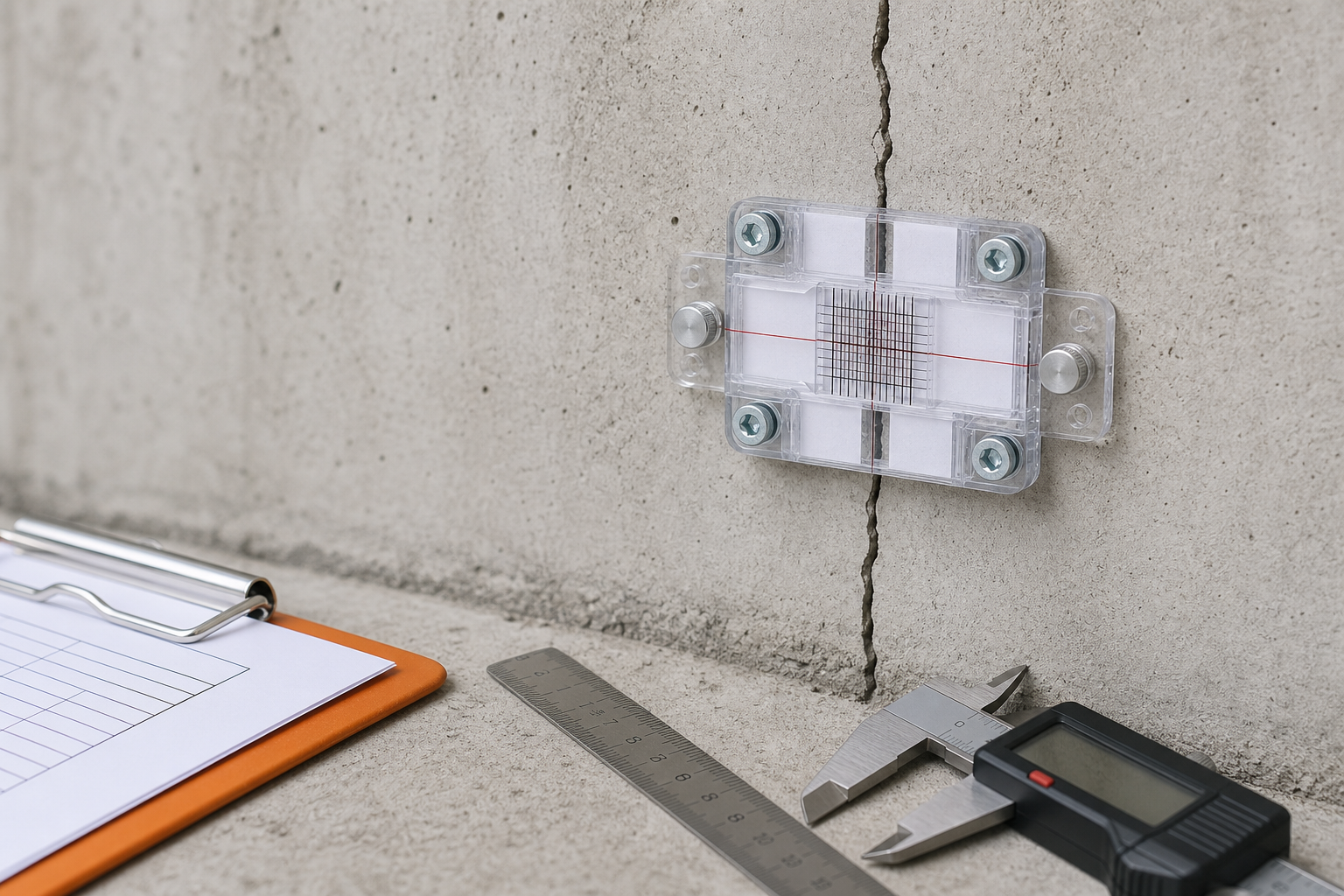
A transparent two-plate monitor fixed across a crack can show relative translation and, depending on the device, rotation. Record an initial reading immediately after installation; the Corps manual warns that the monitor may not read zero when attached. Protect the device from impact and verify that both anchor zones are bonded to sound concrete rather than paint, laitance, or a loose surface layer.
Tell-tales and fixed reference points
Simple tell-tales can reveal that movement occurred, but brittle plaster or glass strips generally do not provide a useful displacement history and may fail from impact or poor adhesion. Demountable mechanical gauges measured between fixed studs can provide more repeatable quantitative readings when the reference points are stable and protected.
Electronic sensors and remote logging
Linear displacement transducers, vibrating-wire sensors, strain devices, or automated imaging can capture frequent readings where access is difficult or movement may occur during short load or temperature cycles. The instrument range, resolution, thermal behavior, power, data logging, calibration, and attachment detail should be selected for the expected movement. More data is useful only when it is tied to temperature, load, time, and a defined engineering threshold.
Set a Monitoring Plan Before Taking Readings
The plan should state the decision to be made. Examples include whether a crack is suitable for rigid injection, whether differential settlement continues, whether a leaking joint is being mistaken for a crack, or whether temporary stabilization is controlling movement. Then define baseline readings, frequency, duration, environmental observations, responsibilities, and trigger levels.
Monitoring duration must cover the behavior being investigated. A few readings over mild weather cannot rule out seasonal thermal movement. One daytime reading cannot describe a crack that cycles under traffic, equipment vibration, reservoir level, tidal exposure, or occupancy. Conversely, a visibly accelerating crack with displacement, crushing, instability, or falling-concrete risk should not be left under routine observation while the team waits for a long data record.
Record influencing variables
At minimum, record date, time, air temperature, surface temperature when relevant, weather, moisture, and unusual loading. For bridges or industrial structures, note traffic, operating state, vibration, or thermal cycles. For foundations, add survey data, settlement points, groundwater, excavation, and nearby construction where applicable. For ASR-affected concrete, expansion measurements and environmental data may be more informative than one isolated crack gauge; see the guide to ASR assessment and repair.
Interpret the Data Without False Precision
A line on a chart is not automatically structural movement. Check for loose anchors, damaged gauges, temperature sensitivity, reading error, surface scaling, and relocation error. Plot displacement with temperature or load when those variables are relevant. Repeated opening and closing around a stable mean suggests different behavior from a steady trend in one direction, but both still need an engineering explanation.
Crack width alone does not determine safety. The engineer should also consider member type, reinforcement, prestress, load path, crack orientation, depth, shear or flexural demand, corrosion, fire or impact history, and signs of instability. Selective cores, petrography, corrosion testing, survey measurements, or structural analysis may be needed. When material condition is uncertain, concrete core testing before repair can connect visible cracking with strength and durability evidence.
Match the Repair to the Observed Behavior
- Stable, structurally significant cracks: engineered injection or another continuity-restoring method may be considered after the cause is addressed.
- Active cyclic cracks: a movement-accommodating seal or properly detailed joint may be more appropriate than a rigid filler.
- Progressive cracks: investigate and stabilize the cause before cosmetic or rigid repair.
- Wet cracks: identify the water path, pressure, chemistry, and drainage condition before selecting grout or sealant.
- Corrosion- or ASR-related cracks: crack filling alone is incomplete unless the deterioration mechanism is mitigated.
- Cracks affecting capacity: repair may need strengthening, load restriction, shoring, or member replacement in addition to sealing.
After repair, retain the baseline map and monitoring history. Selected gauges or nearby reference points can become part of a post-repair structural monitoring plan so the owner can verify that the intervention remains fit for service.
Limitations and Immediate Escalation Triggers
Surface gauges measure local surface movement; they do not reveal crack depth, internal reinforcement condition, hidden delamination, or the complete structural mechanism. Monitoring should never be used to postpone action when there is rapid change, large offset, crushing, buckling, severe corrosion, prestress distress, falling debris, abnormal deflection, loss of support, or any credible instability. Restrict access, shore, unload, or obtain urgent structural review as the condition requires.
FAQ
How long should a concrete crack be monitored before repair?
Long enough to capture the suspected driver. That may mean load cycles, day-night temperature change, wet-dry behavior, or a full seasonal range. Progressive or safety-critical distress requires immediate engineering action rather than a preset waiting period.
Does a crack gauge prove a crack is structural?
No. It measures local relative movement. Structural significance comes from the crack pattern, member behavior, loading, reinforcement, deterioration, analysis, and other investigation evidence.
Can epoxy be injected while a crack is still moving?
Rigid epoxy injection is generally poorly suited to movement that has not been accommodated or stopped. The crack cause and movement demand should be understood before the engineer selects a rigid or flexible treatment.
Should every visible crack be monitored?
No. Monitoring should answer a decision-relevant question. A survey can prioritize cracks by pattern, exposure, width, leakage, location, and structural significance, with instruments placed at representative or critical points.
Authoritative Sources
- U.S. Army Corps of Engineers EM 1110-2-2002, Evaluation and Repair of Concrete Structures
- U.S. Bureau of Reclamation, Guide to Concrete Repair
- American Concrete Institute: Do we always need to repair cracked concrete?
- ACI PRC-224.1-07, Causes, Evaluation, and Repair of Cracks in Concrete Structures
- ACI 562 Concrete Repair Code Portal
- FHWA LTBP Protocol: Concrete Cracking
Need a Crack Assessment Plan?
Structural Rehab can help owners define crack mapping, monitoring locations, investigation tests, decision thresholds, and repair options for concrete buildings, bridges, parking structures, and industrial facilities. Book a structural rehabilitation consultation to turn observations into a defensible repair scope. You can also explore our practical structural repair ebook resources through the site.
Need a professional structural assessment?
Book a consultation with Structural Rehab to evaluate repair priorities, corrosion risks, and rehabilitation options before damage escalates.
Book Consultation