Post-repair structural monitoring is the planned observation, measurement, and review that confirms a concrete repair continues to perform after the contractor leaves the site. It is not a replacement for sound assessment, design, workmanship, or quality control. It is the feedback loop that tells the owner whether the repair assumptions are holding under real exposure, real loading, and real maintenance conditions.
This matters because many repair failures are not sudden mysteries. They begin as small serviceability signals: a crack that reopens, a joint that leaks, a patch edge that debonds, a bearing that transfers restraint into the repaired member, or corrosion activity that continues outside the repair boundary. A monitoring plan turns those signals into engineering data early enough to act.
What Post-Repair Monitoring Should Prove
The monitoring question should be specific. A useful plan does not simply say, “monitor the structure.” It states what risk remains after repair and what evidence will show acceptable performance. For a flexural strengthening project, the question may be whether deflection and crack widths remain within serviceability limits. For corrosion repair, it may be whether new corrosion indicators develop beyond the patch perimeter. For a bridge element, it may be whether leakage, movement, or vibration is changing after rehabilitation.
ACI CODE-562-25 frames concrete repair around assessment, repair design, durability, quality assurance, and project records. That same logic should carry into post-repair ownership: baseline conditions, acceptance records, and future observations need to be traceable enough that the next engineer can compare like with like. The goal is not to collect every possible reading. The goal is to preserve the evidence needed to judge safety, serviceability, and durability over time.
Start With a Baseline Before the Repair Is Hidden
The best monitoring program starts before final acceptance. The owner should keep a baseline package that includes repair drawings, inspection reports, photos, material batch data, testing results, environmental records, and unresolved limitations. For concrete repairs, that baseline may include delamination maps, crack maps, chloride profiles, carbonation depth, concrete resistivity, half-cell potential readings, pull-off results, compressive strength tests, curing records, and as-built repair boundaries.
If the project included concrete delamination survey mapping, keep the original map and the final repair limits together. If corrosion was a driver, preserve the test locations from half-cell potential testing, chloride sampling, and cover checks. If the repair was qualified with mockups and trial panels, keep the acceptance criteria and the final field test results. These records become the comparison point for the first return inspection.
Choose Measurements That Match the Failure Mode
Monitoring should be tied to the deterioration mechanism, not to whatever instrument is easiest to buy. A crack gauge is useful when crack movement is the concern, but it will not prove that reinforcement corrosion has stopped. A corrosion potential map may help screen active corrosion risk, but it does not directly measure section capacity. Vibration data may be useful for a bridge or long-span floor, but it is usually excessive for a small local patch.
For structural behavior, common measurements include crack width, deflection, strain, displacement, rotation, vibration response, and support movement. For durability, the list may include moisture exposure, chloride ingress, carbonation depth, concrete resistivity, corrosion potential, leakage paths, coating condition, and patch edge condition. For repair workmanship, follow-up checks may include sounding, infrared thermography, ground-penetrating radar, pull-off testing where appropriate, and visual review of edges, corners, joints, and interfaces.
The Federal Highway Administration Long-Term Bridge Performance program is a useful model for thinking about durable data. FHWA describes long-term bridge work as detailed periodic inspections, monitoring, nondestructive evaluation, and sensor technologies that track conditions such as traffic loading, cracking, corrosion, overloads, and environment. A building owner does not need to copy a national research program, but the principle is transferable: repeated measurements are valuable only when they are collected consistently and tied to decisions.
Set Trigger Levels Before Trouble Starts
A monitoring plan should define what happens when data changes. Without trigger levels, monitoring becomes a filing exercise. Triggers can be numerical, observational, or both. Examples include a crack widening beyond an agreed threshold, deflection increasing faster than expected, leakage appearing at a repaired joint, coating breakdown exposing steel, new delamination at a patch perimeter, or corrosion readings shifting into a higher-risk zone.
Use tiers rather than a single alarm. A low-level trigger may call for repeat measurement and photo documentation. A medium trigger may require engineering review, targeted NDE, or temporary load management. A high trigger may require immediate restriction, shoring, or emergency evaluation. The trigger values should be set by the licensed design professional because they depend on member type, load path, redundancy, exposure, repair design, and consequence of failure.
Monitoring Frequency Should Reflect Risk
Not every repair needs permanent sensors. Many successful monitoring programs use scheduled inspections, repeat photos from fixed locations, simple gauges, and targeted testing. Higher-risk structures may justify automated sensors, remote data logging, or more frequent review. The right interval depends on deterioration rate, occupancy, traffic, environmental severity, repair criticality, and the uncertainty that remained after design.
A practical owner schedule may include an acceptance baseline, a first review after early service exposure, a seasonal review if temperature or moisture movement matters, and annual or biennial checks thereafter. Bridge owners may align monitoring with inspection cycles and preservation programs. Building owners may align it with reserve studies, facade ordinances, parking structure inspections, or maintenance shutdowns.
Do Not Let Monitoring Hide a Bad Repair Decision
Monitoring is sometimes misused as a substitute for repair. That is risky. If assessment shows a dangerous condition, severe strength deficiency, active instability, or rapid deterioration, the correct response may be restriction, shoring, strengthening, replacement, or a more complete repair. Monitoring can manage uncertainty, but it cannot make an inadequate load path adequate.
The same caution applies when owners use monitoring to postpone root-cause correction. If water is still entering through a failed joint, the repaired concrete below may deteriorate again. If chloride-contaminated concrete remains around a patch without corrosion control, the owner may see ring-anode corrosion. If a strengthened beam has poor detailing at terminations, sensors may simply document distress that should have been prevented in design. Good monitoring complements good repair strategy.
Documentation Owners Should Require
At closeout, ask for a monitoring-ready record set. It should include the repair objective, design assumptions, drawings, product data, test reports, inspection hold points, deviations, photos, as-built repair limits, baseline readings, maintenance requirements, and recommended reinspection intervals. If the project involved strengthening, include load restrictions during cure, inspection access requirements, fire or UV protection limitations for externally bonded systems, and any assumptions from load testing existing concrete structures.
For durability-driven repairs, connect the monitoring plan to material selection and exposure. A repaired element using low-permeability mortar, corrosion mitigation, or a protective surface treatment should still be checked for drainage, cracking, joints, and new contaminant entry. The owner should be able to see how the repair design, repair material selection, and future maintenance plan fit together.
When Sensors Are Worth the Cost
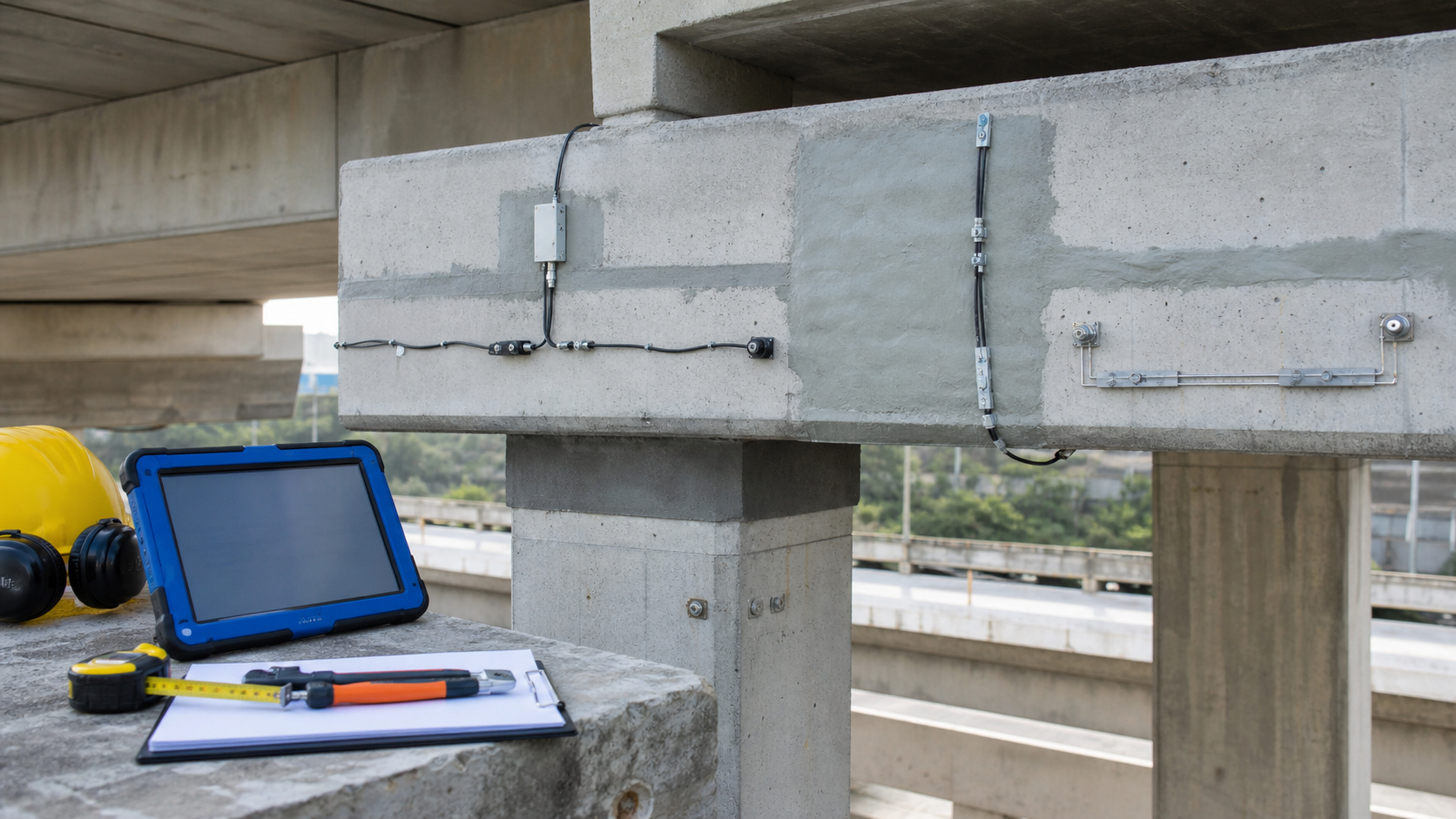
Embedded or mounted sensors make sense when the structure is critical, access is difficult, loads vary significantly, the consequence of missed deterioration is high, or the repair design depends on assumptions that should be checked in service. Examples include major bridge elements, post-tensioned structures, transfer girders, occupied buildings with restricted access, marine structures, and repairs where movement, strain, moisture, or corrosion risk must be trended over time.
Sensor plans still need engineering discipline. Specify calibration, installation protection, data ownership, alert thresholds, review frequency, battery or power needs, replacement procedures, and who is responsible for interpreting the data. Raw dashboards can create false comfort if nobody reviews anomalies or connects them to structural behavior.
FAQ
Is post-repair monitoring required for every concrete repair?
No. Simple nonstructural repairs may only need normal maintenance inspections. Structural, corrosion-driven, movement-sensitive, or high-consequence repairs deserve a written monitoring plan.
Can sensors prove a repair is safe?
Sensors provide data, not approval by themselves. A licensed design professional must decide whether the readings confirm acceptable performance under the project criteria.
What is the most common monitoring mistake?
The common mistake is collecting readings without trigger levels, baseline records, or assigned responsibility for engineering review. Monitoring should lead to decisions.
Sources
- ACI CODE-562-25: Assessment, Repair, and Rehabilitation of Existing Concrete Structures
- ACI 562 Repair Code portal
- FHWA Long-Term Bridge Performance Program overview
- FHWA LTBP Program Protocols, Version 1
- fib Bulletin 109: Existing concrete structures life management, testing and structural health monitoring
Structural Rehab helps owners and engineers turn repair records into practical inspection, monitoring, and maintenance plans. Book a consultation or download the site ebook for structured guidance before your next rehabilitation decision.
Need a professional structural assessment?
Book a consultation with Structural Rehab to evaluate repair priorities, corrosion risks, and rehabilitation options before damage escalates.
Book Consultation