Electrochemical realkalization is a temporary treatment intended to restore an alkaline environment around reinforcing steel in concrete affected by carbonation. It can be valuable when carbonation is widespread but the member remains repairable. It is not a generic cure for every corrosion problem, and it does not replace structural assessment, removal of unsound concrete, or repair of section loss.
The central owner decision is therefore not simply whether the equipment can be installed. It is whether the deterioration mechanism, reinforcement layout, concrete condition, exposure, and required service life make realkalization a defensible part of a complete rehabilitation strategy. The treatment must be designed around the actual structure, not a generic current-and-time recipe.
What electrochemical realkalization does
Carbonation occurs when carbon dioxide reacts with hydrated cement paste and lowers the alkalinity of the concrete. When the carbonation front reaches reinforcing steel, the normally protective passive condition of the steel can be lost. Moisture and oxygen can then support corrosion. A carbonation-depth investigation helps establish where the front lies relative to cover and reinforcement, but depth alone does not define the repair.
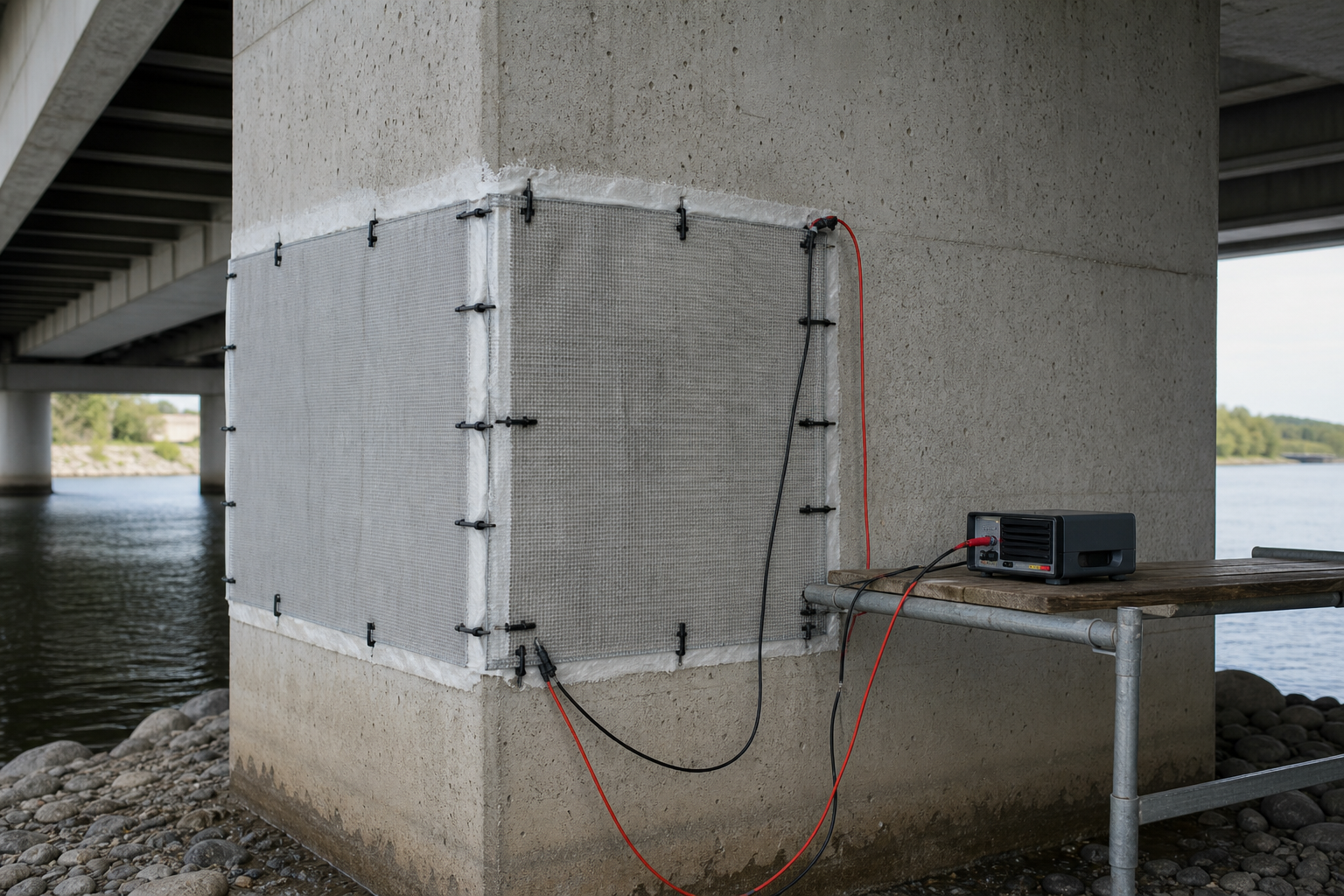
During electrochemical realkalization, the reinforcing cage is connected as the cathode in a temporary direct-current circuit. A temporary external anode, commonly associated with an electrolyte reservoir at the concrete surface, completes the circuit. The treatment is intended to increase alkalinity near the steel and within the carbonated cover. Unlike permanent cathodic protection, the external installation is removed after the specified treatment and verification work.
It is also different from electrochemical chloride extraction. Chloride extraction is selected for chloride-contaminated concrete and seeks to redistribute or remove chloride while increasing alkalinity near the steel. Realkalization primarily addresses carbonation-induced loss of alkalinity. A structure exposed to both mechanisms requires careful diagnosis; the labels are not interchangeable.
Start with cause, condition, and capacity
Confirm carbonation is the controlling mechanism
Map carbonation depth at enough locations to represent different orientations, elevations, exposures, coatings, repairs, cracks, and moisture conditions. Compare results with measured reinforcement cover rather than a nominal drawing value. Supplement the map with visual distress, delamination, cracking, rust staining, moisture pathways, and repair history. Where chlorides may be present, obtain a chloride profile instead of assuming carbonation acts alone.
Electrochemical measurements can add useful context, but none should be treated as a stand-alone structural verdict. A half-cell potential survey maps relative corrosion probability under appropriate conditions; it does not measure section loss or capacity. Linear polarization resistance testing may estimate corrosion rate, subject to its assumptions and field limitations. Concrete resistivity, moisture, temperature, and continuity data help the specialist interpret the electrochemical environment.
Separate durability treatment from structural repair
Realkalization cannot replace lost steel, restore a fractured bar, close a moving structural crack, or re-establish capacity in a deficient member. The engineer should quantify reinforcement section loss, check bond and anchorage where deterioration is significant, and identify concrete that must be removed. Temporary shoring or load restrictions may be necessary before treatment begins.
Spalled, detached, or severely cracked areas usually need conventional repair integrated with the electrochemical work. The repair design must consider compatibility and electrical continuity across the treatment zone. The final strategy may combine local patch repair, realkalization, crack treatment, drainage correction, and surface protection.
Suitability questions before specification
A specialist designer should address at least the following questions:
- Is carbonation, rather than chloride contamination or another mechanism, responsible for loss of steel passivity?
- Is the concrete sufficiently sound and accessible to support a temporary anode and electrolyte system?
- Are the reinforcing bars electrically continuous throughout each intended treatment zone?
- Are there electrically connected embedded metals, prestressing steel, sensitive components, or isolated bars that require special evaluation?
- Can joints, cracks, coatings, dense repairs, saturation differences, and variable cover create nonuniform current distribution?
- Can runoff, electrolyte handling, temporary works, public access, and electrical safety be controlled?
- What post-treatment barrier or exposure-control measures are required to slow renewed carbonation and moisture ingress?
Prestressed or post-tensioned concrete needs particular caution. High cathodic polarization, hydrogen-related risks, tendon continuity, grout condition, and concealed systems require project-specific specialist evaluation. The presence of prestressing should never be treated as a routine extension of a reinforced-concrete procedure.
Design the treatment zones and monitoring plan
The specification should define treatment-zone boundaries from survey data, not convenient elevations alone. Reinforcement continuity and electrical isolation should be tested and documented. The site team should locate embedded services and unintended metallic paths before energizing the system. Structural Rehab’s guide to reinforcement electrical continuity explains why a few convenient readings do not prove that every bar in a large zone is connected.
Provide a baseline record for each zone: concrete condition, carbonation and cover data, corrosion observations, moisture state, continuity results, anode arrangement, connection points, reference locations, and repair interfaces. The designer should specify how voltage, current, current density, charge, electrolyte condition, temperature, interruptions, leakage, and spatial uniformity will be monitored. Acceptance limits must come from the applicable specialist design and project documents, not copied from a different electrochemical technique.
Trial areas are especially useful where the structure has variable materials or a complex repair history. A trial can reveal poor wetting, current concentration, high resistance, difficult edge details, or unsuitable attachment methods before the full installation is committed.
Installation and field QA/QC hold points
Before energizing
Repair unsafe or unsound areas identified by the engineer. Confirm the treatment surface is prepared as specified and that incompatible coatings or contaminants have been addressed. Verify all electrical connections, polarity, continuity, isolation, cable protection, and instrument calibration. Photograph the reinforcement connection points and record baseline readings by zone.
The temporary anode and electrolyte layer must maintain suitable contact over the intended area, including corners and changes in geometry. Detachment, drying, leakage, or bridging across zone boundaries can produce uneven treatment. Establish controlled access, lockout procedures, protected leads, drainage, and a plan for collecting or disposing of treatment materials in accordance with project and local requirements.
During treatment
Record readings at the specified frequency and compare spatial measurements, not only the power-supply total. Investigate unexpected current changes, local heating, drying, electrolyte loss, damaged cables, or abnormal voltage demand. A stable total reading can conceal a poorly treated region if current is concentrated elsewhere.
Any interruption should be time-stamped with its cause and corrective action. Changes to power settings or wettability are design decisions that need traceable authorization. The daily log should identify the instruments used, weather and surface conditions, personnel, zone status, readings, observations, and nonconformances.
After de-energizing
Make the system electrically safe before removal. Inspect the treated surface for damage, residue, staining, cracking, or other changes. Remove temporary materials and reinstate connection locations as designed. Verification sampling should follow a predetermined plan so favorable locations are not selected after the fact.
Acceptance should demonstrate treatment, not promise permanence
Acceptance may include evidence of increased alkalinity or a changed carbonation condition in the specified depth range, together with complete electrical and treatment records. The method, sampling locations, timing, and acceptance criteria should be defined before work begins. Phenolphthalein observations can be useful in carbonation assessment, but color change is a screening boundary, not a direct measurement of corrosion rate, bond, strength, or remaining life.
The closeout record should include as-built treatment zones, connections, equipment, calibrated readings, accumulated treatment data, interruptions, repair locations, verification results, photographs, material information, nonconformances, and corrective actions. It should also identify areas excluded from treatment and the reason for each exclusion.
Realkalization does not make concrete immune to future carbonation. The owner still needs a durable exposure strategy. Repair cracks and water paths where appropriate, select compatible surface protection if required, and establish inspection triggers. Baseline and follow-up corrosion surveys should use repeatable locations and comparable environmental conditions.
Common specification mistakes
- Choosing the method from visible rust alone. Rust does not distinguish carbonation from chlorides, leakage, stray current, or mixed causes.
- Using a universal electrical recipe. Current distribution depends on the actual concrete, steel layout, moisture, geometry, and connections.
- Ignoring hidden discontinuity. Isolated bars can remain untreated even when the main cage responds normally.
- Treating alkalinity as capacity. Realkalization does not replace structural checks or physical repairs.
- Skipping the post-treatment exposure plan. Carbon dioxide and moisture conditions remain unless the rehabilitation strategy addresses them.
- Accepting a total power-supply reading. Zone-level and spatial records are needed to demonstrate coverage.
Owner decision checklist
- Confirm carbonation and map it against measured cover.
- Test for chlorides and mixed deterioration where exposure makes them credible.
- Assess structural safety, section loss, bond, cracking, and delamination.
- Engage an experienced electrochemical repair designer.
- Prove continuity and isolation for each treatment zone.
- Define trial areas, instrumentation, monitoring frequency, and hold points.
- Set verification and acceptance criteria before mobilization.
- Integrate local repairs, surface protection, drainage, and future inspection.
Limitations
Electrochemical realkalization is specialized work, and published guidance does not eliminate the need for project-specific engineering. Performance can be limited by chloride contamination, poor continuity, dense or variable repairs, inaccessible geometry, uncontrolled cracking, prestressing, embedded metals, moisture conditions, or concrete that is too deteriorated to retain. Codes, standards, environmental rules, electrical-safety requirements, and manufacturer procedures applicable to the jurisdiction and system must be checked by the responsible professionals.
Sources and further reading
- FHWA, Foundation Reuse for Highway Bridges, FHWA-HIF-18-055 — overview of electrochemical chloride extraction and realkalization in rehabilitation.
- FHWA-RD-98-088, corrosion-protection history — carbonation mechanism and the context for electrochemical realkalization.
- FHWA-HRT-10-069, Chapter 5 — distinguishes chloride extraction from realkalization and describes the intended alkaline restoration.
- ACI 546R-14, Guide to Concrete Repair preview — identifies realkalization within a broader concrete-repair methodology.
- ACI CODE-562 durability article — current repair-code context for durability treatment selection and field data.
Frequently asked questions
Is realkalization the same as cathodic protection?
No. Realkalization is a temporary electrochemical treatment intended to restore alkalinity in carbonated concrete. Cathodic protection is an ongoing corrosion-control system with continuing performance monitoring.
Can realkalization repair corroded reinforcement?
No. It can address the electrochemical environment, but it cannot restore lost bar area, bond, anchorage, or member capacity. Those conditions require structural evaluation and physical repair where necessary.
Does a phenolphthalein color change prove success?
It can support assessment of an alkaline boundary when used correctly, but it does not prove structural adequacy, corrosion rate, uniform current distribution, or long-term durability by itself.
Can the technique be used when chlorides are present?
Mixed contamination requires specialist evaluation. Realkalization and chloride extraction have different primary purposes, and neither should be selected without representative chloride and carbonation data.
What should the owner monitor afterward?
Inspect cracks, moisture paths, surface protection, repair interfaces, and signs of renewed corrosion. Repeat selected electrochemical and condition surveys at documented locations under comparable conditions.
Plan the rehabilitation around evidence
Structural Rehab can help owners assemble the investigation, repair scope, electrochemical specialist input, QA/QC hold points, and follow-up plan into one auditable rehabilitation strategy. Book a structural rehabilitation consultation, or use the site’s concrete-repair ebook as a practical starting framework before procurement.
Need a professional structural assessment?
Book a consultation with Structural Rehab to evaluate repair priorities, corrosion risks, and rehabilitation options before damage escalates.
Book Consultation