Form-and-pump concrete repair is a controlled way to place a compatible repair material into a confined vertical, horizontal, or overhead cavity. It is most useful when hand placement would leave inaccessible interfaces, congested reinforcement, or deep repair geometry difficult to consolidate. It is not simply “pumping mortar behind a form.” The repair design, material data, formwork design, placement sequence, vent locations, and inspection plan must work together before material arrives.
This guide explains the decisions owners, engineers, contractors, and inspectors should make before approving the method. It does not replace a project-specific repair design, the material manufacturer’s instructions, temporary-works design, or the competent personnel required to manage pumping and formwork hazards.
Start with a repair question, not a pump
First establish why the member needs repair and whether the proposed repair limits are sound. A pump can place material; it cannot correct a wrong assessment, unresolved movement, active corrosion, contaminated substrate, or a repair detail that does not transfer load. Map the repair limits, identify embedded items, and confirm whether the work is structural, protective, or both.
The concrete delamination survey workflow is useful before formwork is designed, because visible loss is often smaller than the unsound area. Where reinforcement is exposed, the engineer should also decide whether cleaning, supplementation, replacement, corrosion mitigation, or changed repair geometry is needed. Repair detailing should not recreate an inadequate-cover condition.
ACI’s ACI 562 repair-code portal describes a repair framework that spans evaluation, structural repair design, durability, construction, and quality assurance. That framework is important here: the placement method is one part of a complete rehabilitation decision.
When form-and-pump placement is a good fit
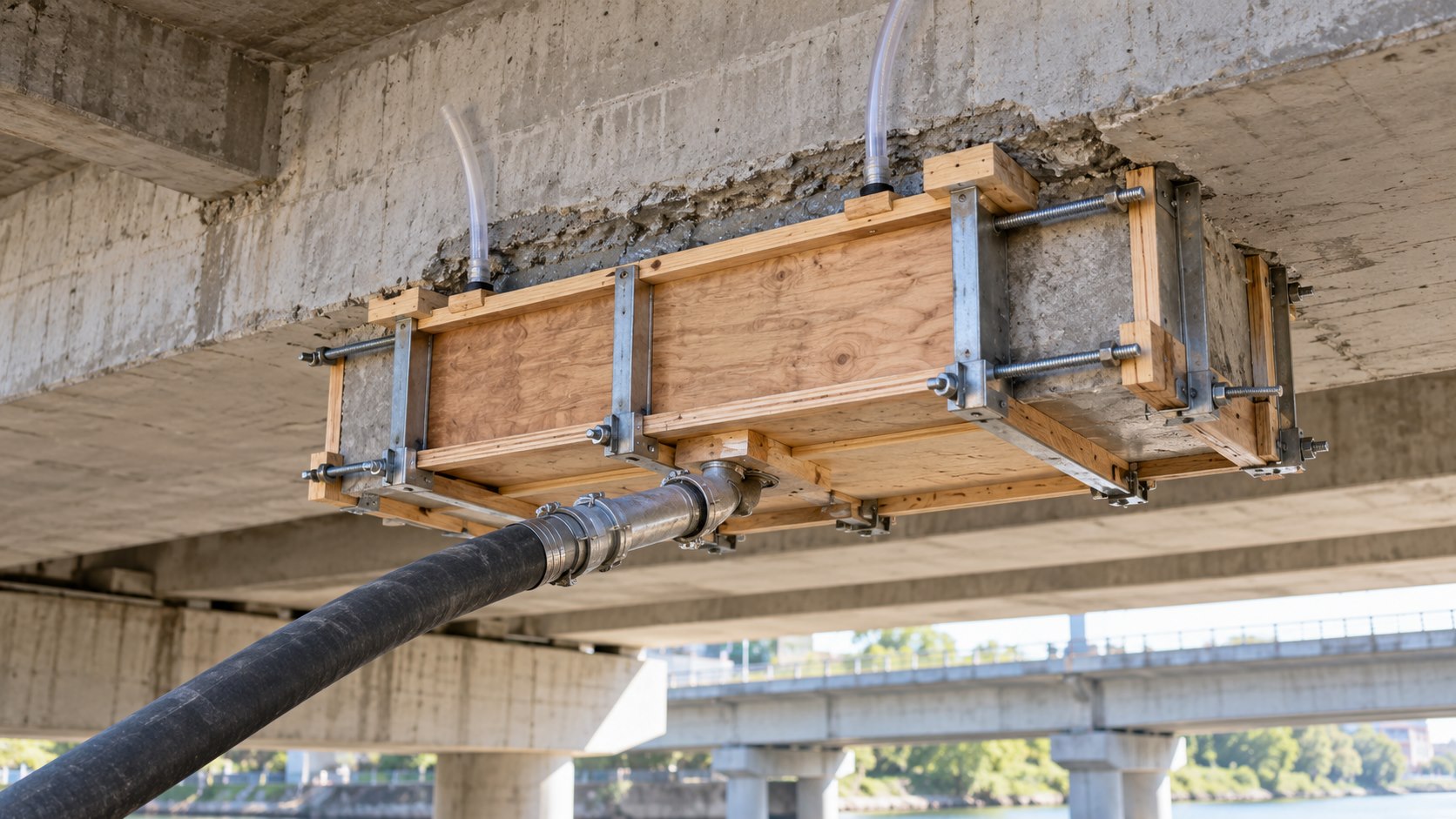
A form-and-pump approach can suit deep vertical repairs, underside repairs, encasement-type repairs, and other cavities where the repair material must contact concealed surfaces. It may reduce repeated handling and, when engineered and executed properly, can help fill a closed cavity more consistently than trying to trowel material into an inaccessible space.
It is not automatically appropriate for every spall. Small, open, shallow patches may be better controlled by hand application; sprayed repairs may suit other geometries. Material pumpability, workable life, aggregate size, line routing, access, form pressure, ventilation, and the ability to inspect the outcome all matter. ACI’s RAP 5 introduction to surface repair using form-and-pump techniques describes the method as placing repair material into a cavity confined by formwork and existing concrete, with pumpability as a necessary material-selection criterion.
Design the formwork, fill path, and vents together
The formwork is temporary works, not a casual enclosure. It must be designed for the expected fluid pressure, placement rate, geometry, attachment to the existing structure, and any restrictions on drilling or anchoring. It also needs joints and penetrations that remain controlled during placement. Do not assume a repair form can be treated like ordinary architectural formwork when material is pumped into a closed cavity.
Plan the fill route before the preconstruction meeting. A common principle is to introduce material at a low point and allow it to rise toward high points, while vents provide a controlled path for displaced air. For overhead work, the sequence and vent arrangement become especially important because trapped air can leave unfilled areas at the bond interface. RAP 5 specifically notes that surfaces likely to trap air should be trimmed or provided with vent tubes.
Set an agreed stop condition for each vent: for example, a stable, representative discharge rather than an assumption that a cavity is full because pump pressure changes. The actual criterion must be established by the repair design and procedure. Do not cap vents or alter the pump route without the authority required by the project documents.
Qualify the repair material and pumping system
“Flowable” does not by itself mean pumpable. The material must be compatible with the repair detail and must also move through the intended hose, fittings, bends, and cavity without segregation, blockage, or premature set. ACI 304.2R’s guide to placing concrete by pumping methods emphasizes mixture consistency, equipment planning, line routing, and trial-mixture evaluation for pumpability and strength.
For a proprietary repair material, use the approved product and its specified water or component ratio. Do not solve a line-flow problem by adding unapproved water, changing components, or extending the mix beyond the manufacturer’s instructions. The site’s packaged repair-material mixing QA/QC guide is related reading for batch control, but the project procedure must also address pump priming, line cleaning, discharge handling, and material working time.
A trial placement is usually the practical way to test the whole system: mixer, batch size, hose diameter, fittings, form, vents, crew sequence, placement rate, and surface finish. Record what is tested and what is accepted. A trial is not evidence that every later batch will work under different temperatures, line lengths, or delays.
Prepare the cavity before mixing begins
Complete removal, substrate preparation, reinforcement work, cleaning, moisture conditioning, bonding treatment, form installation, and inspection release before starting a time-sensitive material. Do not mix first and hope that the last preparation activity finishes before the material loses workable life.
Moisture requirements are material-specific. Cementitious systems may require a conditioned substrate, while other systems may have different requirements. Confirm the approved condition close to placement time and use the SSD substrate-moisture guidance only as related context, not as a substitute for the product instructions. Likewise, a bonding agent must remain within its approved placement window; a visible primer is not proof that its timing remains acceptable.
Use a documented placement sequence
Hold a short pre-placement briefing that names the person controlling the pump, the observer at each vent, the person authorized to stop work, the expected fill sequence, communications, and the disposition plan for blockage or leakage. Verify access and safe exclusion zones before pressure is applied. The crew should not improvise a hose route or stand in the line of a pressurized coupling.
During placement, record batch identification, mix time, component quantities where applicable, start and finish times, material temperature or other required conditions, vents observed, fill sequence, unusual pump pressure, leakage, interruptions, and corrective actions. The concrete repair daily-log guide shows how to connect these observations to a repair location and decision record.
If a blockage, uncontrolled leak, form movement, unexpected discharge, or missed time window occurs, stop under the approved procedure and obtain the required disposition. Restarting may need a defined joint-treatment or removal plan. Never assume that pumping more material will compensate for an uncertain fill.
Verify consolidation and curing without overclaiming
Form-and-pump placement may use pressure to help material contact the prepared substrate, but pressure alone does not prove that every interface is filled or that bond will be durable. Verification should be chosen during repair design: visual checks at vents, volume reconciliation, controlled inspection ports, test panels, sounding after curing, bond tests where specified, or other agreed methods. The method should be proportionate to the repair’s consequence and accessibility.
Protect the repair immediately after placement according to the approved system. The form may assist with protection, but it does not automatically provide the moisture and temperature control a cementitious material needs. Follow the project’s curing requirements and the manufacturer’s instructions; see the related curing and protection QA/QC guide for the questions an inspection plan should answer.
A closed repair cavity is not accepted merely because the pump ran and the form stayed in place. The acceptance record should identify what was placed, where it went, how filling was observed, and what evidence remains pending.
Practical QA/QC hold points
- Before form closure: release repair limits, substrate condition, reinforcement disposition, embedded-item conflicts, and bond treatment.
- Before pumping: release formwork, fill and vent route, material, batch process, line condition, safety controls, and communications.
- During placement: record batches, time windows, vent observations, pressure or leakage concerns, and interruptions.
- After placement: confirm protection and curing, reconcile placed volume, document repairs left in place, and define any test or inspection follow-up.
Frequently asked questions
Can any flowable repair grout be pumped behind a form?
No. The repair detail, approved material, aggregate size, hose and fitting arrangement, line length, working time, and trial results must support pumpability. A product label or a general flow value is not enough by itself.
Why are vent tubes important in overhead repairs?
They provide a managed route for displaced air and a point to observe material reaching high locations. Their number, location, and closure criteria should come from the approved placement procedure.
Does pump pressure verify bond?
No. Pressure can support placement, but it does not replace substrate preparation, material compatibility, curing, and the project’s acceptance testing or inspection plan.
Can formwork be removed as soon as the cavity is full?
Only when the approved procedure, material requirements, temporary-works design, and curing plan allow it. Early removal can disturb a repair or remove needed protection.
Plan the method before the outage begins
For a deep, vertical, or overhead repair that may need a closed-cavity placement method, request a Structural Rehab consultation. Bring the repair drawings, material data, planned formwork, and proposed pump-and-vent sequence so the discussion can focus on assessment, constructability, safety, and evidence-based QA/QC.
Need a professional structural assessment?
Book a consultation with Structural Rehab to evaluate repair priorities, corrosion risks, and rehabilitation options before damage escalates.
Book Consultation