Concrete repair surface temperature is a release condition, not a number to write down after the placement. A patch can have a suitable material and sound repair boundaries yet still face avoidable risk if its substrate is too cold, too hot, or changing rapidly while the crew mixes and places it. The quality plan should turn the approved material instructions and repair specification into a repeatable measurement and decision process.
This guide is for owners, engineers, contractors, and inspectors planning cementitious concrete repairs. It explains how to measure and document substrate temperature without treating one field reading as a repair design or a substitute for the engineer of record.
Why the concrete surface matters
Air temperature is useful context, but it is not the same as the temperature at the bond line. Concrete can gain heat in direct sun, lose heat to wind or a cold structure, and respond more slowly than the surrounding air. The relevant condition is the repair-system condition stated by the project documents: commonly the temperature of the substrate, repair material, and surrounding environment, along with their expected change during placement and early protection.
The TxDOT Concrete Repair Manual illustrates why this must be planned rather than assumed. Its major-spall procedure calls for the repair material and concrete substrate to be between 40°F and 95°F at application, with additional hot- and cold-weather directions. That is a published agency procedure, not a universal limit for every proprietary mortar, overlay, bridge, or building repair. The approved product data, specification, and engineer’s repair detail govern when they differ.
Set a measurement plan before work starts
Use the project’s acceptance criteria
Start with an approved record that identifies the allowable substrate and material temperature, the instrument type, the locations to be checked, the frequency, and the person authorized to release work. Include any limits for rising or falling temperature, wind, solar exposure, moisture condition, working time, and curing protection. Do not convert a forecast into an acceptance decision: the site condition must still be measured.
For a small isolated patch, the plan might require readings at the repair boundary and deepest removal area immediately before placement. A large deck, wall, or shaded-and-sunny elevation may need representative zones identified on a sketch. The aim is to detect meaningful variation, not to create a stack of untraceable readings.
Select and check the instrument
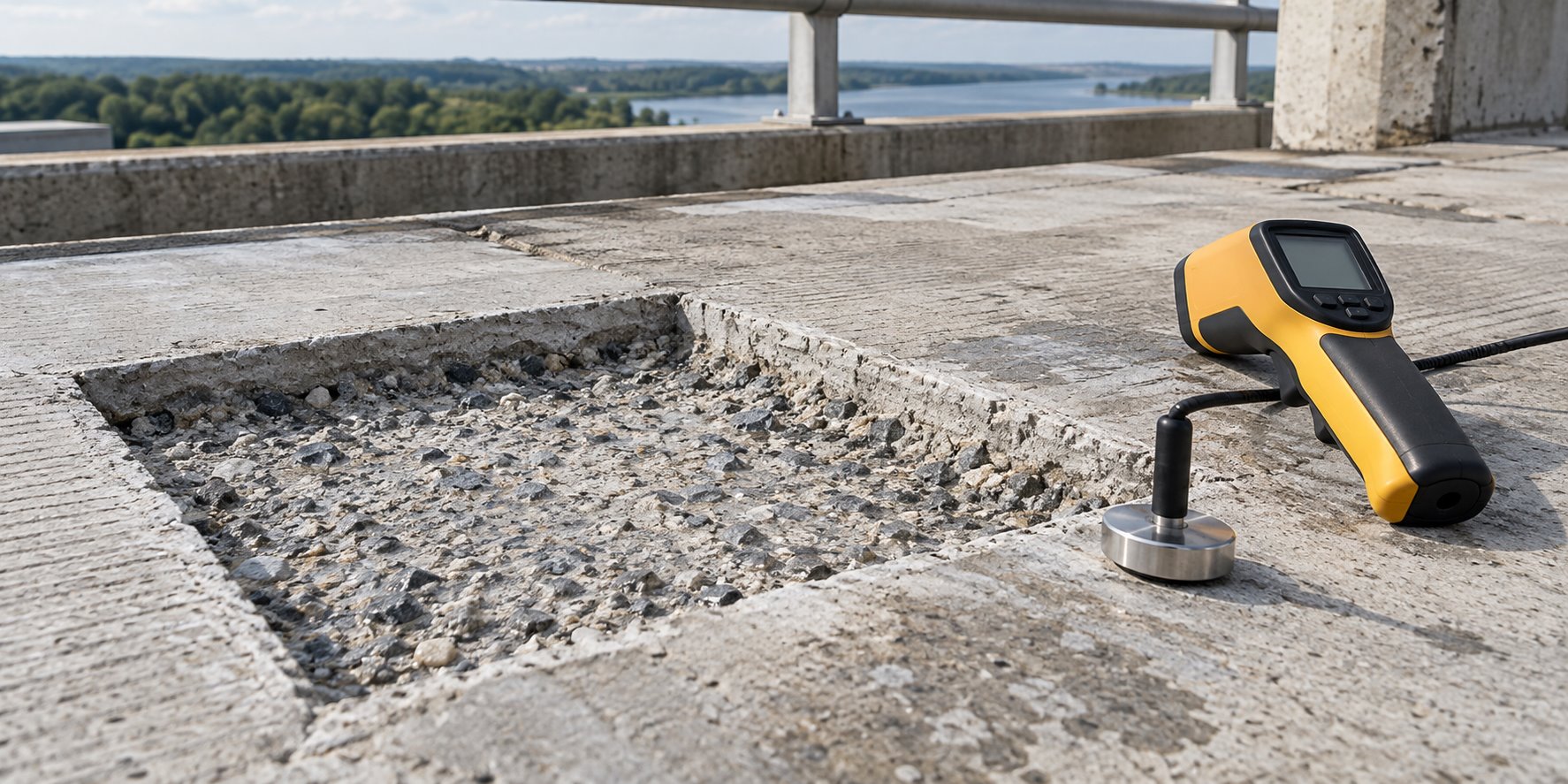
An infrared thermometer is quick, but its reading depends on surface condition, distance, emissivity setting, and what is in its field of view. A contact probe can provide a useful confirmation where it can be held firmly on the prepared substrate. Follow the instrument manufacturer’s instructions, keep it within its calibration interval, and record the instrument ID. If two methods disagree materially, do not average them into a pass; pause and determine which method the project accepts for that surface.
A reading taken from loose debris, standing water, a metal bar, or a sun-heated form does not establish the concrete temperature. Clean and prepare the location as required, identify it in the record, and note unusual exposure. The same discipline supports the controls in our guide to pre-placement inspection for concrete repairs.
Build practical QA/QC hold points
Measure early enough to make a safe decision. A useful sequence has a planning check before batching, a release check after final substrate preparation, and a placement check when conditions are changing. For heat, this can prevent a crew from discovering a hot repair face after the material has already been mixed. For cold conditions, it can verify that protection and the substrate have actually reached the approved condition rather than merely that heaters are present.
Each entry should record the repair ID, date and time, location, substrate temperature, air condition if required, repair-material temperature if required, instrument ID, weather exposure, and observer. A hold point should state the criterion, the release authority, and the action for an out-of-range result. The most useful record is one that enables a later reviewer to reconstruct why the repair proceeded.
Temperature confirmation belongs alongside—not instead of—sound-substrate, cleanliness, profile, moisture, reinforcement-clearance, batch, and curing checks. See our article on concrete repair surface-profile acceptance for the separate issue of preparing the bond surface.
Respond to a condition outside the plan
Do not simply add water, accelerate mixing, or place anyway because a repair area is ready. First protect the prepared substrate from the condition that caused the problem. For heat, that can include shade and timing controls if the specification allows them. For cold, it can include approved enclosure, warming, and protection measures. Re-measure after the corrective action and document the result.
The FHWA Concrete Pavement Preservation Guide notes that concrete and many rapid-setting proprietary repair materials should not be placed when air or pavement temperature is below 4°C (40°F), and that manufacturer preparation and application instructions should be followed. It also explains that consolidation and placement controls affect durability. These points reinforce a basic rule: a temperature reading is one release condition within a coordinated repair system.
If the temperature cannot be brought within the approved range without changing the method, stop and obtain a documented disposition from the responsible engineer or specifier. The alternative may be rescheduling, a different approved material system, or revised protection—not a field improvisation. Our hot-weather concrete repair and cold-weather concrete repair articles discuss the broader planning issues, but neither replaces project requirements.
Coordinate temperature with moisture and material handling
Surface temperature does not answer whether the substrate has the specified moisture condition. For example, a cementitious system may require saturated-surface-dry preparation, while another system may require a dry surface or a specified primer. The repair team must use the requirement for the selected system. A cool-looking or damp-looking substrate is not evidence of compliance.
Likewise, a properly conditioned substrate cannot rescue material that was stored outside its limits, mixed at an unapproved water ratio, or placed after its working time. Verify storage and batch controls separately. Our concrete repair material storage guide can help owners and inspectors frame those checks.
What a concise temperature record looks like
- Repair identification: location, repair ID, orientation, and exposure condition.
- Measurement information: date, time, measured locations, readings, method, and instrument ID.
- Acceptance basis: applicable drawing, specification, approved product data, or engineer instruction.
- Decision: released, held, corrected and rechecked, or escalated for disposition.
- Related evidence: photos, material batch record, moisture/preparation check, and curing-protection log.
Use a repair map when more than one location is measured. An average temperature can hide a critical sunny corner, shaded soffit, or cold interface. Pair the record with concrete repair daily logs so the release decision, placement sequence, and protection measures remain connected.
Limitations
This article does not establish a placement range for a specific repair material or design a hot- or cold-weather program. It does not replace product data, project specifications, code requirements, or engineering judgment. Temperature limits and corrective actions depend on the repair material, exposure, geometry, curing system, structural demand, and local project requirements. Obtain qualified engineering direction when work involves prestressing, primary reinforcement, load-critical members, or conditions outside the approved repair plan.
FAQ
Is air temperature enough for concrete repair acceptance?
No. Air temperature may be part of the acceptance criteria, but it can differ substantially from the concrete surface. Measure the locations and conditions required by the approved repair system.
Can an infrared thermometer be used by itself?
Only if the project accepts it and it is used according to its instructions. Its field of view and surface conditions can affect the result; a contact measurement may be appropriate for confirmation.
What should happen if a reading is out of range?
Hold the affected work, apply only approved corrective measures, recheck, and obtain a documented disposition if the criteria cannot be met.
Need a repair-readiness review? Structural Rehab can help owners organize condition evidence, QA/QC hold points, and questions for a qualified repair engineer before work proceeds.
Sources
- TxDOT Concrete Repair Manual
- FHWA Concrete Pavement Preservation Guide
- TxDOT 2024 Specifications, Item 720
Need a professional structural assessment?
Book a consultation with Structural Rehab to evaluate repair priorities, corrosion risks, and rehabilitation options before damage escalates.
Book Consultation