Concrete repair shrinkage testing helps a project team judge whether a proposed cementitious material has suitable dimensional behavior for a restrained patch or overlay. The useful evidence is a documented test history, not a single low number on a product sheet. Before comparing products, establish what was measured, when the reference reading was taken, how specimens were cured, and which conditions changed during testing.
A shrinkage value without a conditioning history is not a repair acceptance decision. Laboratory results can support material qualification, but they do not establish the cracking date, bond performance, or service life of a repaired beam, column, slab, or bridge deck. This guide focuses on reviewing shrinkage reports; use the broader concrete repair material selection guide for the complete selection process.
Why restraint changes the repair question
New repair material and older concrete do not necessarily undergo the same movement. A bonded patch cannot contract as freely as an isolated laboratory specimen. Its response depends on restraint, stiffness, tensile behavior, creep, geometry, and the evolving properties of both materials. The Bureau of Reclamation’s report on compatibility of concrete repairs and overlays explains why the interaction of these properties matters to cracking and debonding.
For a project review, identify the intended function first. A protective cover patch and an enlargement designed to carry load have different consequences if cracking develops. Record the repair thickness, plan dimensions, orientation, exposed faces, adjacent joints, environmental exposure, and proposed construction sequence. Give the laboratory and material reviewer this context before ordering a standard test package.
Free length change and restrained cracking answer different questions
ASTM C157: compare length-change behavior
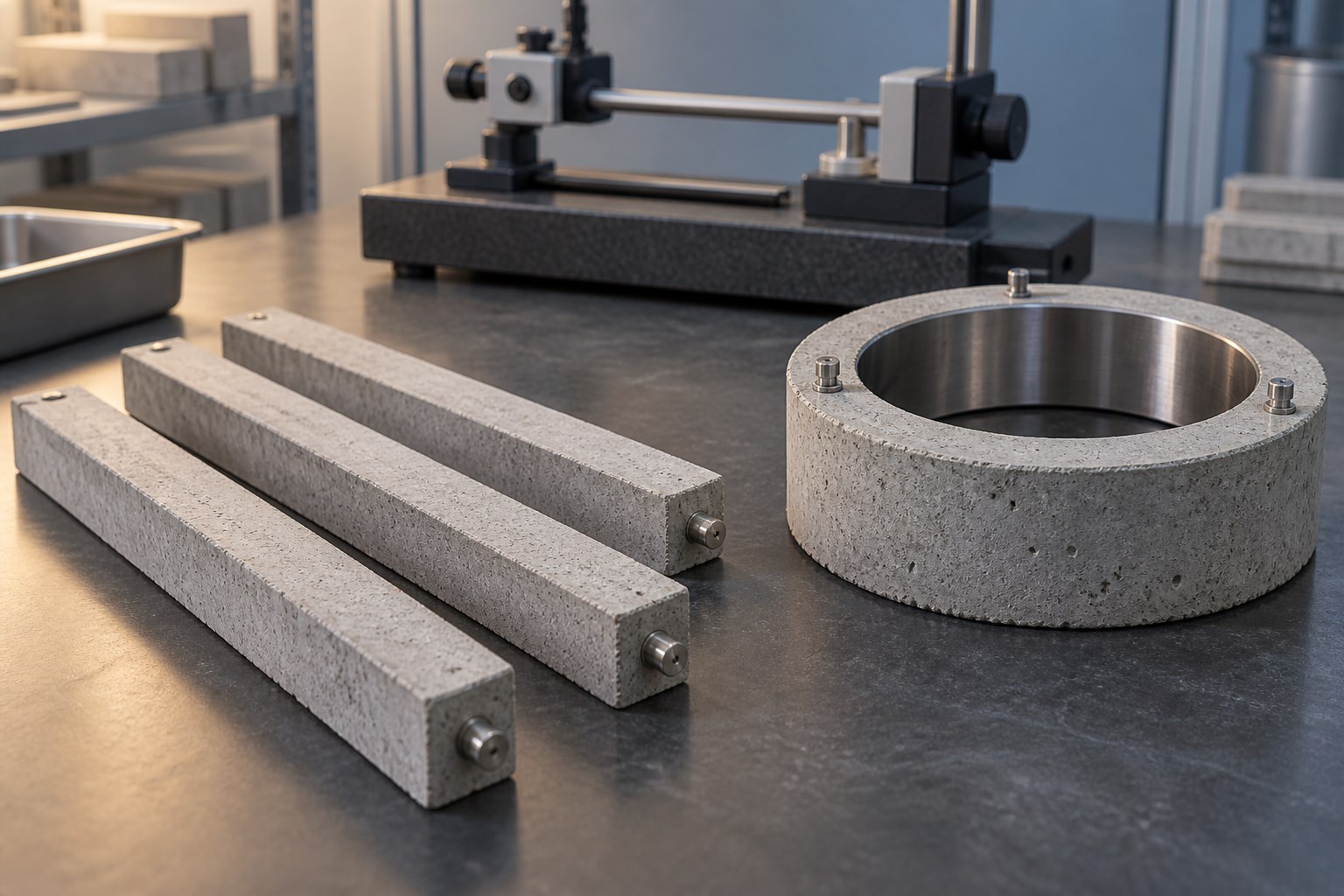
ASTM C157/C157M-24e1 measures length changes of laboratory-made hardened cement mortar or concrete under controlled moisture and temperature conditions, excluding changes caused by external force and temperature change. It is useful for comparing mixtures. The report must identify departures from standard mixing, sampling, curing, or storage conditions prominently.
A C157 reference is therefore the beginning of a review. Ask for the actual report and its conditioning sequence. An early reference reading followed by drying and a later reference reading after prolonged moist curing represent different measurement histories. A result reported at a particular age cannot be compared fairly until the reference age and duration of drying are understood.
ASTM C1581: compare cracking under laboratory restraint
ASTM C1581/C1581M-24 addresses age at cracking and induced tensile-stress characteristics under restrained shrinkage. Its purpose is relative comparison, not prediction of the cracking age of a particular structure. Its scope is limited to mixtures with nominal maximum aggregate size of 13 mm or less, and it is not intended for expansive materials. An uncracked specimen still requires interpretation of the test duration and stress-development information.
Do not substitute a ring-test result for free length-change data or treat either as a bond test. If a report falls outside the method’s scope, ask the engineer and laboratory to establish an appropriate evaluation route before accepting the result.
Build a comparison sheet before ranking products
Prepare one row per proposed product and one column per evidence requirement. Mark missing information explicitly rather than converting blanks into assumed passes. The following is a practical submittal-review checklist, not a replacement for a laboratory standard or project specification:
- Identity: exact product version, manufacturer, report date, laboratory, and traceable sample or lot identification.
- Mixture: liquid dosage, component proportions, aggregate extension, and any additions represented by the specimens.
- Method: standard designation and edition, modifications, specimen configuration, and stated limits of applicability.
- Time history: molding, demolding, reference reading, curing transitions, start of drying, measurement ages, and termination.
- Exposure: curing method, storage environment, and recorded deviations or interruptions.
- Results: individual specimen values, reported summary, sign convention, units, observations, and any excluded specimens with reasons.
- Decision: the applicable project requirement, reviewer, outstanding questions, and written disposition.
For example, suppose two suppliers both advertise a result at 28 days. One report identifies 28 days of drying after its specified cure; the other identifies specimen age but gives no drying duration. The second product is not automatically worse. The evidence is incomplete for ranking, so request clarification or comparable testing. Do not invent a correction factor to make the numbers appear equivalent.
Likewise, check whether the proposed field mixture includes aggregate extension while the test used the unextended product. Ask which configuration is approved for the repair thickness and whether supporting data represent it. Keep this question connected to the controlled batching requirements in jobsite mixing of packaged concrete repair materials.
Review nonshrink and shrinkage-compensating claims carefully
ACI’s TechNote on nonshrink and shrinkage-compensating labels cautions that these descriptions have limited selection value without supporting volume-change data over time. Early expansion and subsequent contraction must be considered together; a label alone does not establish dimensional compatibility with the substrate.
Ask the supplier which test supports the claim, what part of the material’s history it captures, and which curing and restraint assumptions apply. A grout designation should not be interpreted as a promise that every bonded patch will remain crack-free. Refer expansive systems for specialist review instead of automatically adding a ring test that excludes them from its intended scope.
Turn qualification evidence into project hold points
Before procurement
The responsible engineer should define the necessary evidence and acceptance criteria before competing submissions arrive. State whether the requirement concerns free length change, restrained cracking behavior, another dimensional property, or a combined assessment. Specify the test conditions and reporting ages that matter to the decision. This article deliberately supplies no universal shrinkage limit: the appropriate criterion depends on the repair system and governing project requirements.
Provide a written route for incomplete or noncomparable reports. Options may include clarification, supplementary testing, a representative trial, or rejection of the submission. Agree on who can release the hold point and how a product substitution triggers review. Procurement pressure should not turn a missing laboratory condition into an undocumented assumption.
Before production repair
Where required by the repair plan, use concrete repair mockups and trial panels to examine the proposed material and installation process together. Define observation locations, timing, records, and responses to cracking in advance. A short successful trial supports constructability review, but it cannot establish long-term field performance by itself.
Confirm that the accepted product, mixture, placement thickness, and curing plan match the approved submittal. If a contractor proposes an alternative liquid dosage, aggregate source, or curing regime, document it as a change requiring disposition. Retain the accepted laboratory report alongside the approved material documents so the inspector can trace the basis of acceptance.
During placement and after curing
Record actual batch identification, repair location, liquid quantity, placement date, and curing actions. These records connect a qualification decision to the installed work. Apply the project-specific curing and protection plan; a favorable laboratory report does not excuse missed field controls.
If cracks appear, map their position, pattern, timing, and change before choosing a remedy. Preserve photographs and construction records, and obtain an engineering assessment of the cause and significance. Do not assume every crack is shrinkage or inject a crack solely because the repair material passed a laboratory test. Structural movement, substrate conditions, workmanship, and exposure may need investigation.
Keep material qualification separate from installed bond acceptance
Shrinkage reports describe selected material behavior under a test arrangement. Installed acceptance must also address the interface and the repair’s intended function. Where specified, pull-off testing for concrete repair bond provides a different evidence stream, with its own sampling, timing, criteria, and failure-location interpretation.
Organize the handover file so these decisions remain distinguishable. Include the approved shrinkage reports, material submittal, change decisions, trial records, batch-to-location log, curing records, crack observations, and installed acceptance results. A later reviewer should be able to determine both why the material was selected and how the actual work was accepted.
Limitations of shrinkage testing for concrete repair
ACI’s explanation of shrinkage measurement emphasizes that laboratory methods do not reproduce actual structural behavior because size, restraint, and exposure differ. Treat test-based product ranking as one input to engineering judgment. Do not convert a laboratory cracking age into a maintenance interval or use a length-change result to calculate field crack width without an appropriate analysis.
This guidance concerns cementitious repair-material qualification. It does not define a test program for every resin, expansive grout, shotcrete mixture, large-aggregate concrete, or proprietary system. Obtain the applicable complete standards and product instructions, use competent laboratories, and resolve departures with the responsible engineer. The editorial workflow suggested here supplements those requirements.
Frequently asked questions
Is the lowest shrinkage number always the best choice?
No. First establish whether the results are comparable. Then review the repair’s other required properties and the interaction with the existing concrete. A favorable value cannot settle the whole material-selection decision.
Does an uncracked ring specimen prove a repair will not crack?
No. It reports an outcome within a defined laboratory period and restraint arrangement. Field geometry, construction, and exposure remain separate considerations. Record the observation period rather than describing the product as permanently crack-free.
Should every repair batch receive shrinkage testing?
There is no universal frequency offered here. The project specification should distinguish prequalification from production verification and identify triggers for additional testing. Do not replace that plan with either blanket testing or no testing.
What should an owner request when reports cannot be compared?
Request a short written gap list from the reviewer, the supplier’s clarification, and a proposed resolution with responsibility and timing. Keep the affected approval open until the evidence meets the agreed requirements.
Review the evidence before approving the material
For project-specific discussion, book a Structural Rehab consultation. Bring the repair drawings, proposed products, complete laboratory reports, site exposure information, and acceptance specification. These records make it possible to discuss the actual decision rather than a marketing claim.
Need a professional structural assessment?
Book a consultation with Structural Rehab to evaluate repair priorities, corrosion risks, and rehabilitation options before damage escalates.
Book Consultation