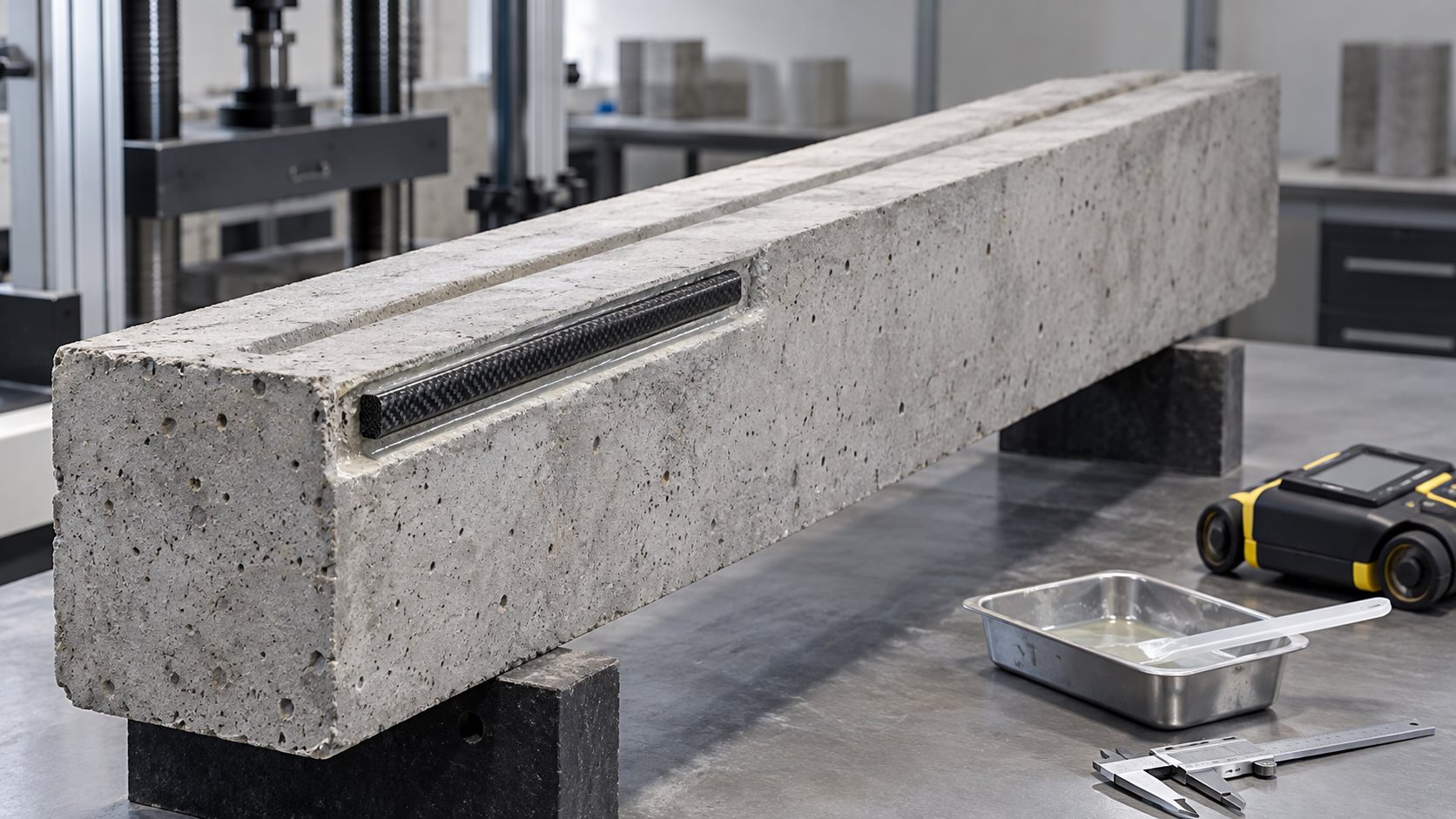
Near-surface-mounted (NSM) fiber-reinforced polymer (FRP) is a strengthening method for an existing concrete member when analysis shows that the member needs added capacity and a bonded system is suitable. Instead of placing a composite laminate on the face of the member, the contractor cuts shallow grooves in sound concrete, places FRP bars or strips in adhesive, and completes the specified finish. The grooves give the reinforcement bond on multiple sides and can offer more physical protection than a surface-bonded laminate.
That description should not be mistaken for a field recipe. NSM FRP is a structural intervention: the engineer of record must establish the demand, the existing member’s condition, the reinforcement layout, the governing design standard, and the allowable construction sequence. This article is a QA/QC-oriented guide for owners, designers, and inspectors deciding how to control that work on reinforced-concrete beams and similar members.
When NSM FRP is a credible concrete-strengthening option
NSM FRP is commonly considered where an existing reinforced-concrete member needs flexural or shear strengthening, where surface access is limited, or where an externally bonded system would be unusually exposed. The Federal Highway Administration describes NSM as placing FRP in a cut groove with adhesive; the three-sided bond can improve force transfer and help protect the retrofit from environmental exposure. It remains only one option among section enlargement, external post-tensioning, steel plate systems, and externally bonded FRP.
A good decision begins with the reason capacity is inadequate: changed use, revised loading, deterioration after the cause is controlled, detailing deficiencies, or a rehabilitation strategy. It also begins with an assessment of the actual structure. Review drawings and modifications, locate embedded reinforcement and utilities, map cracking and delamination, determine whether deterioration is active, and assess the concrete that will receive the groove. A groove cut through weak, delaminated, chloride-contaminated, or fire-damaged concrete does not create a dependable load path.
For condition evidence before a repair design, the site’s guides to concrete core testing, rebar locating, and delamination surveys provide useful adjacent workflows. Those investigations do not replace the design calculations, but they reduce the risk of designing to assumptions.
Design decisions that must be settled before cutting
Define the strengthening objective and limit state
The design documents should identify the required function: flexural capacity, shear capacity, serviceability, or a combination. They should state the applicable code or guide, load combinations, material design properties, bond and development assumptions, fire and environmental exposure requirements, and the limit states being checked. ACI’s current FRP strengthening resources include ACI PRC-440.2-23 and ACI CODE-440.13-24; project requirements should use the edition adopted for the job rather than relying on a generic online detail.
Do not assume that a stronger bar automatically gives a stronger member. Existing reinforcement, concrete strength, anchorage, shear behavior, deflection, cracking, and credible failure modes all govern. In particular, NSM reinforcement needs enough development length and a compatible groove/adhesive/detailing arrangement to transfer force. The owner should require sealed calculations and drawings that show the beginning and end of each reinforcement run, curtailment, spacing, cover, interfaces with repairs, and any special end treatment.
Protect existing reinforcement and post-tensioning
Groove layout is not a layout exercise done at the saw. It must be coordinated with verified reinforcement locations, cover, ducts, tendons, utilities, and planned repair boundaries. The engineer should specify an exclusion zone and a stop-work response if scanning or cutting finds an unexpected embedment. Striking a tendon or cutting primary reinforcement is a serious structural event, not a minor installation defect.
Resolve the substrate before the FRP system
Remove unsound concrete and complete compatible structural repairs before the strengthening system is installed. If the member has corrosion-driven damage, stop or manage the corrosion mechanism; if it has active movement, identify the movement cause; if it has moisture exposure, select an adhesive and protection system that suits the manufacturer’s limits and the design exposure. NSM FRP should not be used to conceal unresolved deterioration.
A practical NSM FRP QA/QC hold-point plan
1. Preconstruction submittals and trial work
Before production, review the FRP product data, adhesive data, batch and shelf-life records, installation instructions, installer qualifications, safety data, method statement, inspection plan, and cure/temperature controls. The method statement should make clear who approves substrate repairs, groove dimensions, cleaning, adhesive mixing, bar placement, and finished work.
Use a representative trial installation when the project has unfamiliar geometry, overhead work, congested steel, a novel adhesive, or high consequence. A trial can prove that the specified tools reach the groove, that dust collection works, and that the crew can fully bed the reinforcement without voids. It is not a substitute for the structural design. For the broader value of trials, see concrete repair mockups and trial panels.
2. Survey, layout, and groove acceptance
Record the member ID, grid or station, intended groove locations, verified embedments, and approved changes before cutting. Check groove width, depth, alignment, end location, spacing, and edge distance against the issued drawings. Do not let a field crew change a groove path to avoid reinforcing steel without written engineering review; that change can alter development, cover, or structural behavior.
After cutting, inspect the groove faces and base. They should be sound, free of loose material, and prepared according to the system requirements. Remove cutting slurry and dust by the approved method. The final condition matters more than a visual claim that the groove was “clean”: record the cleaning method, substrate temperature, ambient conditions, and any moisture observation required by the adhesive manufacturer.
3. Adhesive controls
Verify product identity, lot number, expiry date, storage condition, mix ratio, mixing time, pot life, and permitted installation temperature. Use only the adhesive system used in the design and qualification submittal. A substituted resin, expired kit, or mix that has exceeded its working time is a nonconformance even when it looks normal in the groove.
Plan quantities so continuous placement is possible within the stated working time. Batch records should identify where each mix was used. If the work pauses, follow the manufacturer’s documented procedure for the interface; do not simply add fresh adhesive over a partially cured surface without approval.
4. FRP placement and consolidation
Confirm the bar or strip type, size, surface condition, cut length, and orientation before placement. Set it to the designed position with a method that maintains cover and does not introduce a kink or damage. Fill the groove so the reinforcement is fully bedded and the specified cover or finish is achieved. Inspectors should look for unfilled ends, exposed composite, entrapped air, discontinuities, or contamination—not merely whether a dark bar is visible in a groove.
Use the project’s defined response for suspected voids. Depending on the design and system instructions, that may require localized removal and replacement, additional investigation, or engineering disposition. Unapproved drilling into a completed NSM system is not an acceptable way to “check” it.
5. Cure, protection, and handover
Protect the system for the specified cure period and environmental limits. Do not place finishes, load the member, or allow impact before the design and product requirements permit it. The closeout package should include approved submittals, as-built groove locations, photographs, daily environmental logs, adhesive batch records, installation dates, inspection sign-offs, deviations, and engineer dispositions.
A simple principle helps frame the records: the strengthening detail is only as credible as the documented bond path from existing concrete to adhesive to FRP. That is why a traceable hold-point plan is more valuable than a stack of generic product brochures.
Common failure modes and how to prevent them
- Cutting into embedded steel or tendons: locate embedments, use a controlled cutting plan, and stop for engineering review when findings differ from the survey.
- Bonding to unsound or contaminated concrete: assess, remove, and repair defective concrete before groove acceptance.
- Adhesive installed outside its limits: manage temperature, moisture, shelf life, mix ratio, and working time with batch records.
- Insufficient development or altered detailing: require engineer approval for every field change to length, spacing, end location, or groove path.
- Premature loading or exposure: protect the system until the specified cure and finish requirements are met.
Limits owners should understand
NSM FRP is not a universal repair. It may be unsuitable where the member cannot be safely accessed, the groove would compromise critical existing reinforcement, the concrete is too degraded to support the bond zone, a fire or impact requirement cannot be met, or the installation environment exceeds system limits. It also does not resolve a foundation movement, overstressed connection, or active corrosion mechanism by itself.
FRP systems have material-specific behavior, including directional strength, rupture rather than yielding, adhesive dependency, and temperature/fire considerations. The engineer must define the appropriate protection and inspection approach. For another framing of system selection, compare the site’s CFRP versus steel plate strengthening guide; the choice should follow structural analysis and durability needs, not a product preference.
Owner’s decision checklist
- Confirm why capacity is inadequate and whether deterioration causes are controlled.
- Commission an assessment with verified geometry, reinforcement layout, and substrate condition.
- Require a sealed NSM FRP design and a project-specific installation/inspection plan.
- Approve materials, installer qualifications, trial work, and hold points before cutting begins.
- Retain as-built and batch records for future inspection and asset management.
Frequently asked questions
Is near-surface-mounted FRP the same as externally bonded FRP?
No. Externally bonded FRP is applied to the member surface. NSM FRP is placed in grooves cut into sound concrete and bonded with the specified adhesive. Both require engineered design and controlled substrate preparation.
Can NSM FRP be installed over cracked or spalled concrete?
Not without first assessing the cause and repairing or removing unsound material as directed by the engineer. The groove must provide a dependable bond zone; cosmetic concealment is not structural rehabilitation.
How is NSM FRP quality verified?
Verification is primarily process-based: approved design and materials, surveyed layout, groove acceptance, adhesive batch and environmental records, installation observations, cure protection, and documented resolution of deviations. Any project-specific test or inspection method should be defined by the engineer and system requirements.
Plan the strengthening as a controlled structural repair
Near-surface-mounted FRP can be an effective option for a qualified existing concrete member, but it rewards disciplined assessment, detailing, and installation control. Structural Rehab can help owners frame the assessment scope, repair documentation, and QA/QC questions before a strengthening project moves to construction. When a project needs a scoped discussion, use the consultation booking page.
Sources
- American Concrete Institute: FRP strengthening resources
- ACI 440.2R-17 preview: Guide for the Design and Construction of Externally Bonded FRP Systems
- FHWA: Report on Techniques for Bridge Strengthening
- FHWA National Highway Institute: bonded repair and retrofit of concrete structures using FRP
Need a professional structural assessment?
Book a consultation with Structural Rehab to evaluate repair priorities, corrosion risks, and rehabilitation options before damage escalates.
Book Consultation