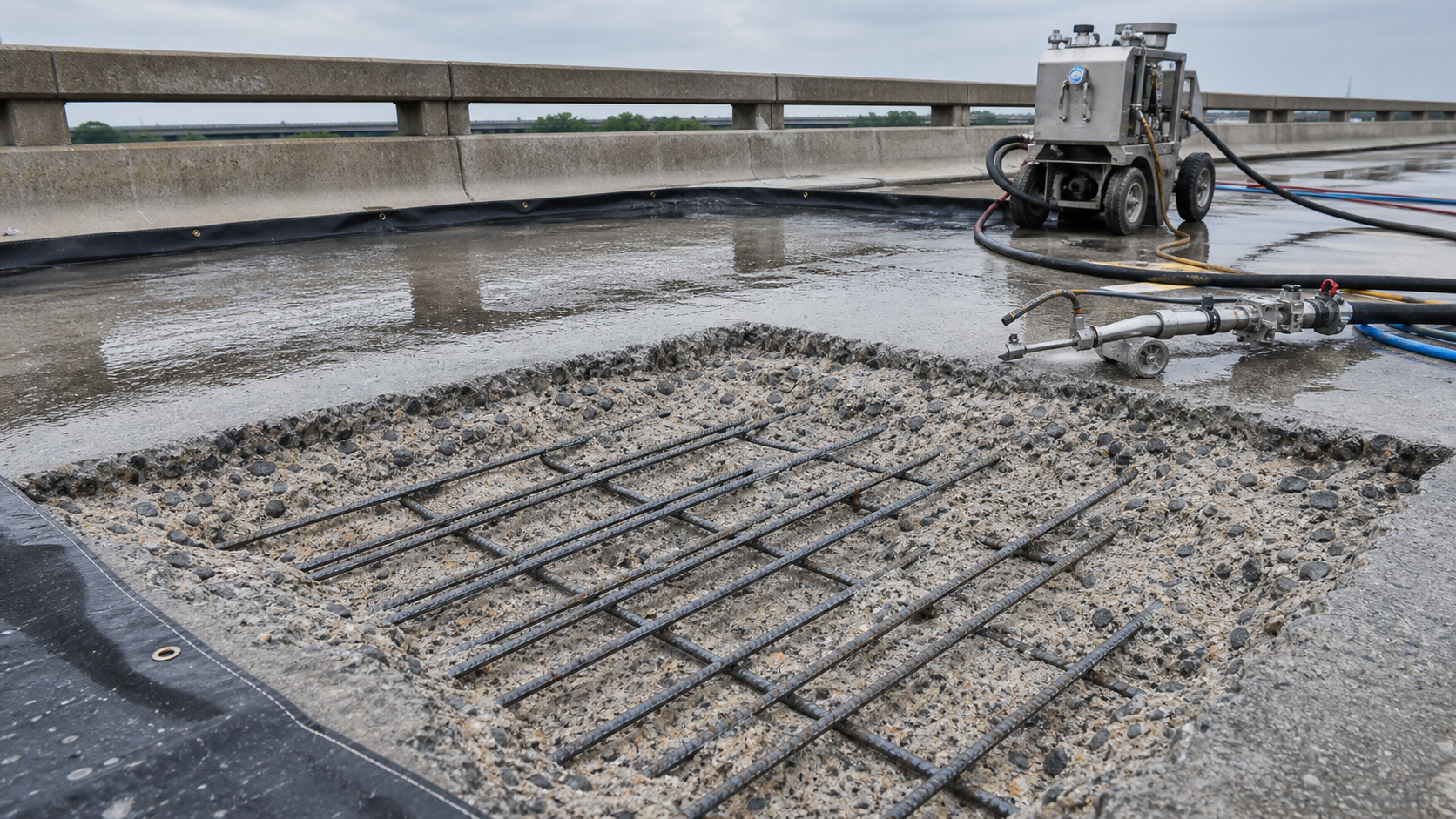
Hydrodemolition concrete repair is often specified when a project needs selective concrete removal without the bruising and microcracking that aggressive mechanical breakers can leave behind. It uses high-pressure water to remove deteriorated or low-strength concrete, clean around reinforcement, and create a rough repair substrate. That can be valuable on bridge decks, parking structures, marine structures, industrial slabs, and other reinforced concrete members where bond, durability, and reinforcement preservation matter.
The method is not automatically better for every repair. Hydrodemolition should be treated as an engineered removal method, not a magic eraser. The owner still needs a diagnosis, repair limits, containment plan, competent operators, verification tests, and clear acceptance criteria before new concrete, mortar, shotcrete, or overlay materials are placed.
Where Hydrodemolition Fits in Structural Repair
Hydrodemolition is most useful where the repair objective is to remove unsound concrete while keeping sound concrete and reinforcement as intact as practical. It can help expose aggregate for bond, remove chloride-contaminated cover concrete, clean around reinforcing bars, and reach irregular pockets of deterioration that would be difficult to chase neatly with handheld chipping tools.
FHWA bridge overlay research describes bridge deck rehabilitation as a common response to deterioration from loading, freeze-thaw distress, cracking, delamination, and corrosion of internal reinforcement. In FHWA laboratory work on UHPC bridge deck overlays, substrates prepared by hydrodemolition were part of the test matrix, and the report notes that hydrodemolition can offer the possibility of higher bond strength than scarification because mechanical preparation may introduce substrate microcracking. That does not mean every project needs hydrodemolition; it means the removal method must support the intended bond and durability requirement.
Before specifying the method, pair it with a concrete delamination survey, cover and reinforcement mapping, drainage review, and selective testing where the cause of distress is uncertain. Hydrodemolition removes material; it does not decide how much material should be removed.
Good Candidate Uses
Bridge Deck Overlay Preparation
Bridge decks are a natural application because chloride exposure, delamination, reinforcement congestion, and traffic phasing often make removal quality critical. FHWA construction review guidance for latex-modified concrete overlays highlights practical deck preparation controls: sound and mark delaminations, calibrate hydrodemolition equipment, use qualified personnel, clean the deck and reinforcing steel, and maintain clearance around exposed bars. Those points are field controls, not paperwork details. If removal is too shallow, contaminated or weak concrete can remain. If removal is too aggressive, the project may create unnecessary full-depth repairs or damage the load path.
Repairs Around Congested Reinforcement
Where reinforcement must remain in place, high-pressure water can remove concrete around bars without the direct impact energy of jackhammers. That can be useful at beam soffits, pier caps, column faces, slab edges, and bearing seats. The engineer still needs to verify bar section loss, development length, splice condition, and whether supplemental bars or anchors are required. If reinforcement is corroded or debonded, cleaning alone is not a capacity restoration plan.
Surface Preparation for Bond-Critical Overlays
Hydrodemolition can leave a highly roughened, aggregate-exposed surface. That may help bond for overlays and repair materials, but the required profile must still be specified and verified. Tie the method to a measurable surface condition, such as the concrete surface profile, cleanliness, saturated surface-dry condition where required, absence of laitance, and pull-off test requirements. For more on profile control, see Structural Rehab’s guide to concrete surface profile before repair.
When Hydrodemolition May Be the Wrong Tool
Do not choose hydrodemolition only because it sounds advanced. It may be unsuitable where water containment is impossible, where runoff could contaminate drainage systems, where nearby equipment or occupied areas cannot be protected, or where access prevents controlled robotic or handheld work. It can also be a poor fit for very small isolated patches if setup, wastewater control, and mobilization outweigh the benefit.
Hydrodemolition also does not remove the need for structural judgment. If cores show widespread low strength, petrographic distress, or deep chloride contamination, the repair strategy may require larger removal zones, cathodic protection, overlay design, strengthening, or replacement. Use concrete core testing before repair when strength, petrography, chloride profile, or hidden distress controls the decision.
Pre-Work Questions Owners Should Require
- What is the removal criterion? Define whether the target is delaminated concrete, chloride-contaminated cover, low-strength concrete, a minimum overlay depth, or a combination.
- How will the equipment be calibrated? Require a trial area that confirms pressure, travel speed, standoff distance, nozzle pattern, and removal depth before production work.
- What happens at reinforcement? Define minimum clearance around exposed bars, cleaning requirements, bar replacement triggers, and engineer review points for section loss.
- How will wastewater and debris be contained? Require collection, filtration or disposal procedures, and protection of drains, bearings, traffic areas, and adjacent occupied spaces.
- How will the prepared surface be accepted? Include profile, cleanliness, soundness, moisture condition, and bond testing requirements before placement.
These questions belong in the specification and preconstruction meeting. ACI 562-25 is framed around assessment, repair, durability, construction, quality assurance, and project records for existing concrete structures. That is the right mindset: the removal method should be one controlled step inside a documented repair process.
QA/QC Hold Points During Hydrodemolition
1. Trial Area and Calibration
Start with a representative trial area. The engineer and contractor should agree on the desired removal depth, surface roughness, rebar exposure limits, and visual acceptance criteria before production work begins. Record the equipment settings and do not treat them as permanent if substrate strength changes across the structure. Deteriorated concrete may remove faster than sound concrete; that is useful only if the team understands what the equipment is reacting to.
2. Sounding and Removal Limit Checks
After each pass, verify remaining concrete by sounding, visual inspection, and probing where needed. Repair boundaries should be squared or detailed for the selected repair material, not left as random feather edges. If removal exposes unexpected cracks, voids, heavily corroded reinforcement, or section loss, stop and get engineering direction before covering the condition.
3. Reinforcement Cleaning and Assessment
Hydrodemolition can clean around reinforcement, but acceptance should be based on actual condition. Document bar size, remaining section, spacing, lap condition, and clearance. Where corrosion has reduced area or bond, the engineer may require supplemental reinforcement, mechanical splices, dowels, or a different repair geometry. Avoid the common mistake of placing repair material around bars that look clean but no longer have adequate capacity or development.
4. Surface Cleanliness and Bond Testing
Before placement, the surface should be free of loose aggregate, slurry, laitance, standing water unless the material requires it, and contaminants. ASTM C1583/C1583M-25 covers pull-off testing for the tensile strength of concrete near a prepared surface and bond strength of repair or overlay materials. It is especially useful when the owner needs evidence that the substrate and interface are ready for a bond-critical repair. Structural Rehab has a separate guide to pull-off adhesion testing before concrete repair.
5. Repair Material Compatibility
The removal profile must match the material that follows. A thin polymer overlay, cementitious repair mortar, shotcrete layer, cast-in-place patch, and UHPC overlay can have different substrate moisture, profile, cure, and placement requirements. Review the repair material data, project specification, and mockup results together. For material selection basics, see concrete repair material selection and UHPC bridge deck overlays.
Safety and Environmental Controls
Hydrodemolition reduces dust compared with many dry mechanical methods, but it introduces high-pressure water, noise, flying debris, slippery surfaces, wastewater, and traffic control hazards. OSHA’s construction silica standard requires employers to control respirable crystalline silica exposure and maintain a written exposure control plan when covered tasks create exposure. Wet methods are part of many silica controls, but the contractor still needs task-specific safety planning, PPE, restricted access, and housekeeping procedures.
Containment is also an engineering issue. Wastewater can carry cement fines, chlorides, metals, and other contaminants. On bridges, protect drains, bearings, waterways, traffic below, and expansion joints. In buildings and parking structures, protect occupied areas, electrical systems, elevators, and post-tensioning components. The repair plan should say where the water goes before work starts.
A Practical Acceptance Checklist
- Investigation confirms the cause and extent of deterioration.
- Removal limits are shown on drawings or field maps.
- Hydrodemolition trial area is accepted and settings are recorded.
- Exposed reinforcement is cleaned, measured, and reviewed for section loss.
- Prepared concrete is sound, clean, and profiled for the selected repair material.
- Containment and wastewater disposal records are complete.
- Pull-off, sounding, or other acceptance tests match the specification.
- Repair material placement, curing, and protection follow the approved method statement.
- Photos, test results, and changed repair limits are included in the closeout package.
FAQ
Is hydrodemolition always better than jackhammer removal?
No. Hydrodemolition can reduce impact damage and improve access around reinforcement, but it has higher setup, containment, water, and wastewater demands. The right choice depends on repair size, access, contamination, bond requirements, structure type, and safety controls.
Can hydrodemolition damage reinforcing steel?
It is generally used to preserve reinforcement, but poor control can still create problems around bars, adjacent concrete, embedded items, or post-tensioning components. Locate embedded systems first, use qualified operators, and require engineering review when unexpected steel or ducts are exposed.
Does hydrodemolition remove chlorides from a concrete deck?
It removes the concrete that is cut away, which may include chloride-contaminated cover. It does not neutralize chlorides left in remaining concrete. Use chloride testing and cover-depth data to decide whether removal depth, protection, galvanic anodes, cathodic protection, or overlay systems are needed.
What should be tested after hydrodemolition?
Typical checks include visual inspection, sounding, reinforcement condition, surface cleanliness, surface profile, moisture condition, and pull-off testing where bond is critical. The exact tests should match the repair material and project specification.
Who should approve the final removal limits?
The licensed design professional or engineer responsible for the repair should approve changes that affect load path, reinforcement exposure, repair depth, member capacity, or durability strategy. Field crews should not expand or reduce structural repair limits without documented direction.
Sources
- FHWA-HRT-17-097, Ultra-High Performance Concrete for Bridge Deck Overlays
- FHWA, Latex Modified Concrete Mix Design Generic Review
- ICRI CSRT resource list, including hydrodemolition and surface preparation guidelines
- ASTM C1583/C1583M-25 pull-off test method
- ACI 562 Repair Code portal
- ACI CODE-562-25 product page
- OSHA 29 CFR 1926.1153 Respirable Crystalline Silica
Need help deciding whether hydrodemolition belongs in your concrete repair scope? Structural Rehab can review the deterioration evidence, repair limits, QA/QC plan, and owner risk before work starts. Book a consultation or download the Structural Rehab ebook from the site for practical repair planning guidance.
Need a professional structural assessment?
Book a consultation with Structural Rehab to evaluate repair priorities, corrosion risks, and rehabilitation options before damage escalates.
Book Consultation