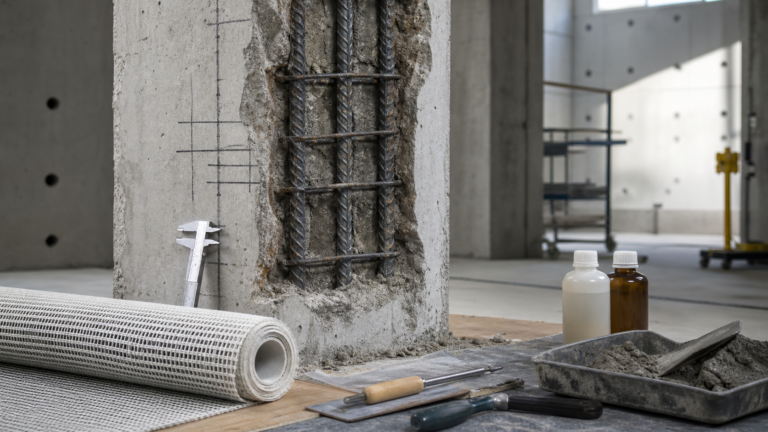
TRM and Corrosion Inhibitors for Aging RC Column Repair
How textile-reinforced mortar and corrosion inhibitors can work together in aging reinforced concrete column repair, with design checks, limits, QA, and source links.
How textile-reinforced mortar and corrosion inhibitors can work together in aging reinforced concrete column repair, with design checks, limits, QA, and source links.

A practical guide to steel structure repair for corrosion, fatigue cracks, weld defects, and section loss, including inspection, stop-hole limits, welded or bolted repairs, CFRP strengthening, laser cladding considerations, coating restoration, and quality control.

A practical 2026 guide to corrosion-damaged reinforced concrete repair, including assessment, corrosion mapping, patch repair, UHPFRC/UHPC overlays, textile-reinforced mortar systems, corrosion protection, quality control, and service-life planning.

Dry film thickness testing helps confirm whether protective coatings on steel structures were applied within specification. Learn where DFT fits in coating QA, how to plan readings, and what defects to avoid.
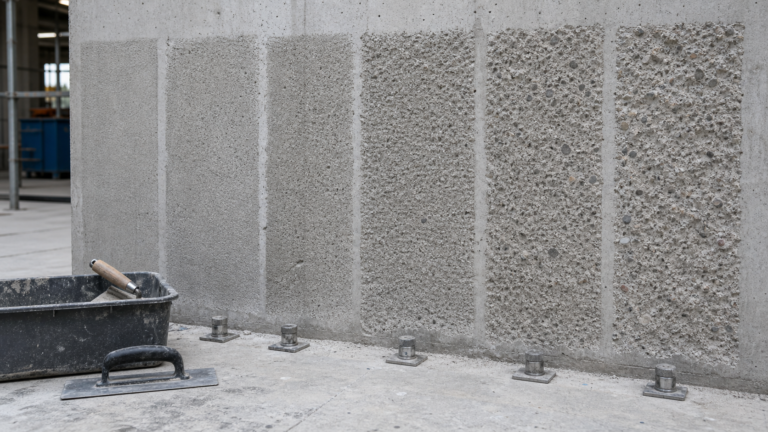
Concrete surface profile controls mechanical bond for repair mortars, overlays, waterproofing, and protective coatings. Learn how to specify CSP, verify preparation, and avoid bond failures before concrete repair.

Pull-off adhesion testing helps verify concrete surface preparation, repair bond strength, and failure mode before full-scale concrete repair or overlay work. Learn when to use it and how to interpret results.
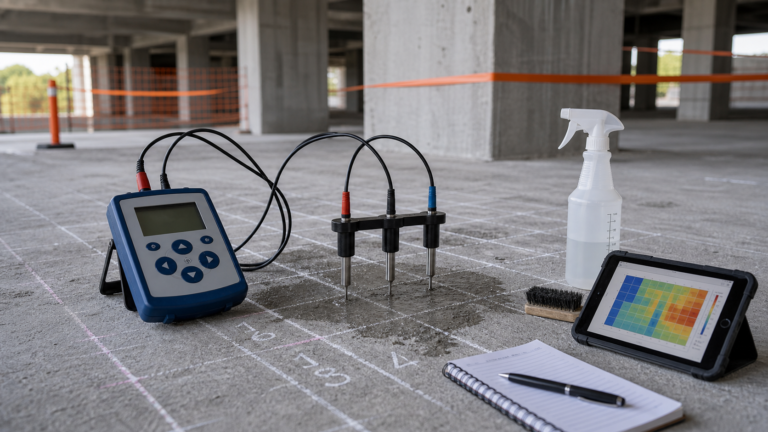
Concrete resistivity testing helps identify moisture and ion-transport conditions that influence reinforcement corrosion risk before repair. Learn when to use it, how to interpret it, and how it supports repair planning.

Learn how chloride testing, cover-depth checks, half-cell potential readings, and corrosion-risk maps help engineers choose durable concrete repair and protection systems.

A practical guide to concrete spalling repair, reinforcement corrosion diagnosis, patch repair methods, waterproofing, protective coatings, and long-term prevention.